The Representation of Social Identity and Popular Culture through Generation Z Language Variation on TikTok
DOI:
https://doi.org/10.30736/ej.v13i1.1381Keywords:
Sociolinguistics, Generation Z, TikTok, Social Identity, Sociolinguistics; Generation Z; TikTok; Social Identity; Popular Culture.Abstract
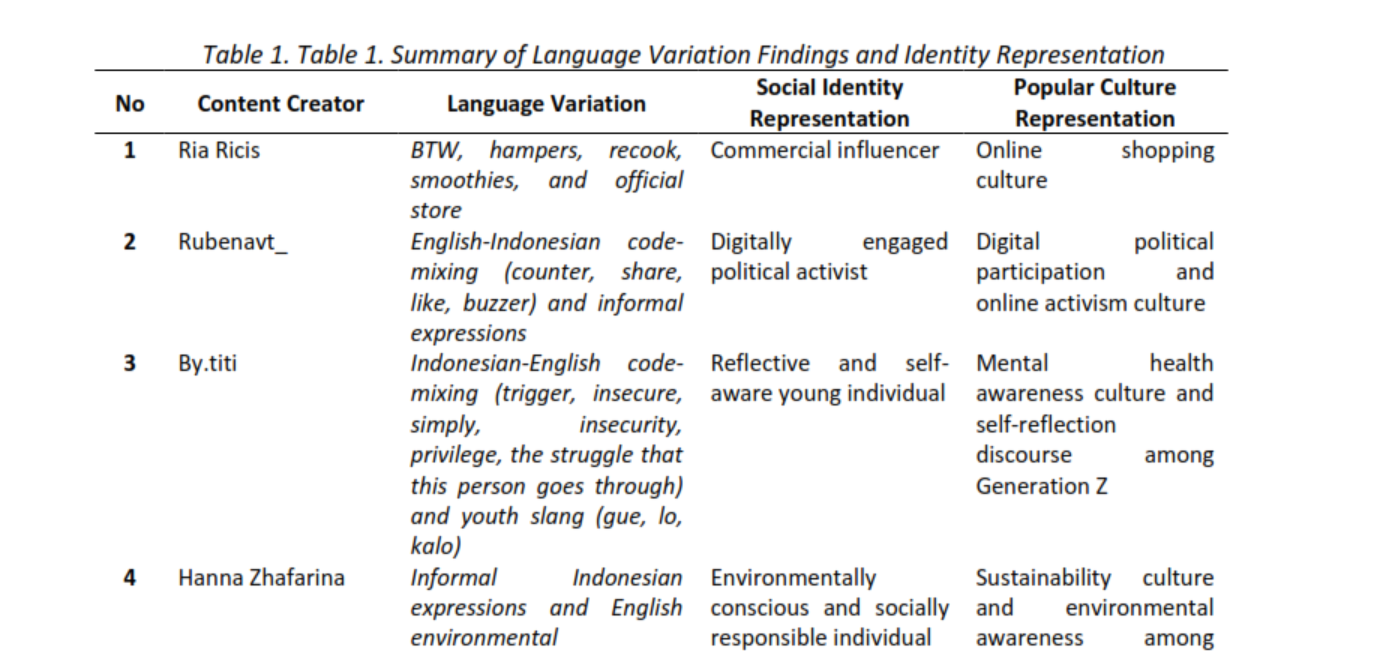
This study aims to describe and analyze the representation of social identity and popular culture reflected in the language variations used by Generation Z on the social media platform TikTok. The phenomenon of code-mixing and the use of slang expressions constitute the primary focus of this research in order to examine how language transforms within the digital ecosystem. This study employs a descriptive qualitative method with a sociolinguistic approach. The data were collected through observation and note-taking techniques from ten TikTok video uploads created by various content creators representing issues related to commerce, politics, mental health, and lifestyle. The data analysis was conducted by relating linguistic units to their social contexts using Pierre Bourdieu’s Theory of Cultural Capital and Howard Giles’ Communication Accommodation Theory. The findings reveal that: (1) language variations, particularly English-Indonesian code-mixing, function as a form of cultural capital to project a modern and cosmopolitan identity; (2) the use of slang and acronyms serves as a means of communication efficiency and group solidarity formation; and (3) language use on TikTok represents fluid social identities, ranging from egalitarian and masculine identities to reflective self-representations. The study concludes that TikTok has become a dynamic linguistic laboratory in which Generation Z negotiates identity and disseminates new popular cultural values through inclusive linguistic creativity.
Downloads
References
Arshad, S., Shabir, Z., Aslam, S., & Farid, S. (2025). The impact of social media on language use and identity: A sociolinguistic analysis. Journal of Applied Linguistics and TESOL (JALT), 8(2), 871-883.
Barthes, R. (1957). Mythologies. Paris: Éditions du Seuil.
Bhat, M. A. (2026). Digital Discourse and Identity: Exploring Linguistic Patterns in Language Identity Formation on Social Media. Journal of Literature and Linguistics Studies, 4(2), 16-33.
Bourdieu, P. (1986). The Forms of Capital. In J. Richardson (Ed.), Handbook of Theory and Research for the Sociology of Education.
Jabeen, S. S., & Nawaz, H. I. (2025). Morphological innovations in Gen Z language and their impact on English language usage. Journal of Applied Linguistics and TESOL (JALT), 8(1), 86-107.
Connell, R. W. (2005). Masculinities. Berkeley: University of California Press.
Crystal, D. (2011). Internet Linguistics: A Student Guide. London: Routledge.
Daristin, P. E., & Dewi, R. F. (2024). Study of Humor in The Use of Javanese Language on The Instagram Account" D_Kadoor.
Dewi, A., & Pratiwi, D. (2025). Pragmatic Analysis of Maxim Violations in Animated Conversations on the Dhot Design Channel. E-LINK JOURNAL, 12(01), 1-12.
Fairclough, N. (2013). Critical Discourse Analysis: The Critical Study of Language. London: Routledge.
Goffman, E. (1959). The Presentation of Self in Everyday Life. New York: Doubleday.
Hall, S. (1997). Representation: Cultural Representations and Signifying Practices. London: SAGE Publications.
Hanafi, I., Wardana, A., Fadillah, N. N., & Rahman, Y. B. R. (2025). Sociopragmatics Analysis of The Joker’s Madness Through Face Theory. E-LINK JOURNAL, 12(02), 113-122.
Holmes, J. (2013). An Introduction to Sociolinguistics. London: Routledge.
Ilaturahmi, A., & Thamsin, A. C. (2019). Penggunaan Kalimat Dalam Teks Berita Siswa Kelas VIII B SMP Pembangunan Laboratorium UNP Tahun Ajaran 2018. Jurnal Pendidikan Bahasa dan Sastra Indonesia UNP, 8(1), 15-29.
Ilaturahmi, A. (2021). Synthesis Skills and Student Thinking Patterns in Scientific Writing. Aksis: Jurnal Pendidikan Bahasa dan Sastra Indonesia, 5(1), 65-85.
Miles, M. B., & Huberman, A. M. (1994). Qualitative Data Analysis. Thousand Oaks, CA: SAGE Publications.
Nurman, M. (2018). An Analysis Of Slang Language As Social Variation Produced By Men And Women’s Speech In Lamongan. E-LINK JOURNAL, 5(1), 30-34.
Pineda, M. N., et al. (2022). Code-Switching and Code-Mixing in Social Media: A Sociolinguistic Analysis of Gen Z Communication. Journal of Language and Digital Culture.
Sham, N. M. N., Kadir, Z. A., Mohamad, F., & Johar, E. M. (2025). Exploring Slang Dynamics and Semantic Shifts in Digital Communication: A Study of Generation Z on TikTok. International Journal of Research and Innovation in Social Science, IX, 497-514.
Sudaryanto. (2015). Metode dan Aneka Teknik Analisis Bahasa. Yogyakarta: Sanata Dharma University Press.
Sugiyono. (2017). Metode Penelitian Kuantitatif, Kualitatif, dan R&D. Bandung: Alfabeta.
Türkan, D. (2025). Generational Preferences in Media Consumption: A Comparative Study of English Language Development in Terms of Vocabulary Among EFL Teachers (Master's thesis, Istanbul Aydin University (Turkey)).
Zappavigna, M. (2012). The Discourse of Twitter and Social Media. London: Continuum.
Downloads
Published
How to Cite
Issue
Section
License
Copyright (c) 2026 Auzi Ilaturahmi, Juwita Sekar Arum Ramadhani

This work is licensed under a Creative Commons Attribution 4.0 International License.