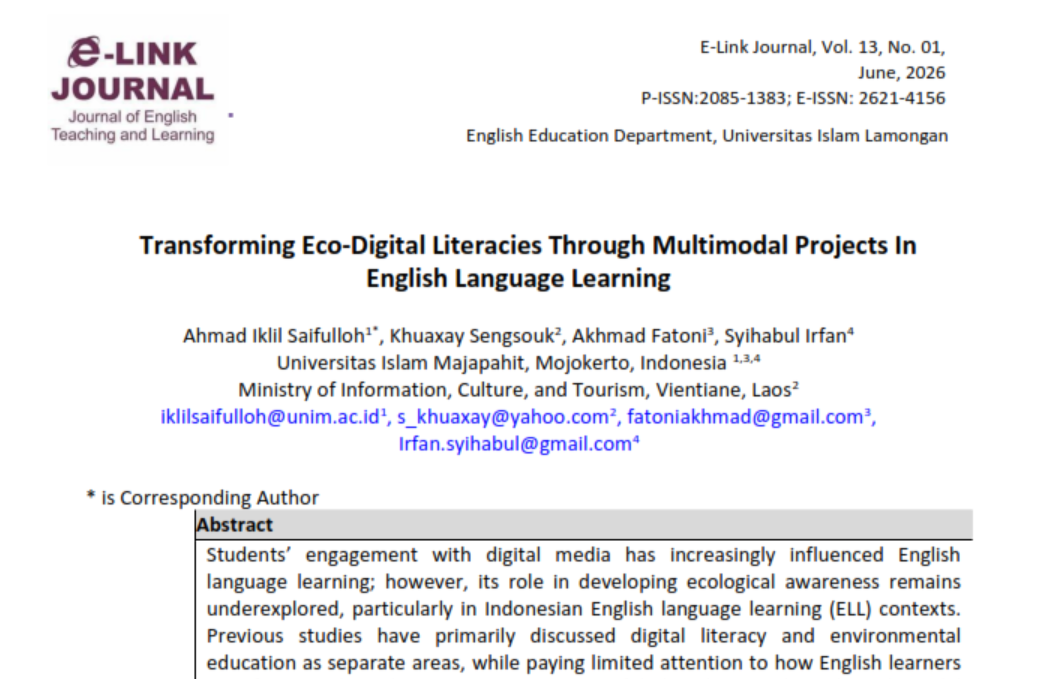
Transforming Eco-Digital Literacies Through Multimodal Projects in English Language Learning
DOI:
https://doi.org/10.30736/ej.v13i1.1392Keywords:
transformed practice, multiliteracies pedagogy, ecolinguistics, eco-digital literacy, English language learnersAbstract
Students’ engagement with digital media has increasingly influenced English language learning; however, its role in developing ecological awareness remains underexplored, particularly in Indonesian English language learning (ELL) contexts. Previous studies have primarily discussed digital literacy and environmental education as separate areas, while paying limited attention to how English learners transform ecological concerns into meaningful digital texts through multimodal practices. This study investigates how transformed practice within multiliteracies pedagogy supported undergraduate students in redesigning local environmental issues into multimodal digital texts. Employing a qualitative case study approach, this research involved twelve undergraduate English language learners and collected data from student artefacts, reflective accounts, classroom observations, and semi-structured interviews. The digital artefacts included a reforestation documentary, the Nawasena educational game, digital journalism, and fandom-based environmental posters. Data were analysed thematically using multiliteracies pedagogy, particularly the concept of transformed practice, and ecolinguistic perspectives to examine how students constructed and communicated ecological meanings through different modes. The findings indicate that students used digital media not only to complete academic assignments but also to communicate ecological concerns and engage audiences beyond the classroom. The documentary project developed place-based ecological storytelling; the game project integrated environmental decision-making through narrative interaction; the journalism project encouraged critical ecological discourse; and the poster project transformed youth popular culture into an environmental campaign language. Nevertheless, the transformation process varied among students due to differences in digital experience, access, and confidence in using multimodal resources. The study suggests that eco-digital projects can support English learning by connecting language practices with students’ local ecological experiences, cultural resources, and environmental concerns.
Downloads
References
Bhaba, H. K. (1994). The Location of Culture. In Routledge (Vol. 3, Issue 1).
Bill Cope, M. K. (2000). Multiliteracies, literacy learning and the design of social futures.
Cazden, C. B. (1996). A pedagogy of multiliteracies: Designing social futures. Harvard Educational Review, 66(1), 60–92. https://doi.org/10.17763/haer.66.1.17370n67v22j160u
Chen, W. T., & Hsieh, M. H. (2023). Environmental self-identity, self-efficacy, and the emergence of green opinion leaders: An exploratory study. Heliyon, 9(6), e17351. https://doi.org/10.1016/j.heliyon.2023.e17351
Cope, B., & Kalantzis, M. (2009). “Multiliteracies”: New Literacies, New Learning. In Pedagogies: An International Journal (Vol. 4, Issue 3). https://doi.org/10.1080/15544800903076044
Cope, B., & Kalantzis, M. (2016). The things you do to know: An introduction to the pedagogy of multiliteracies. A Pedagogy of Multiliteracies: Learning by Design, 1–36. https://doi.org/10.1057/9781137539724
Dewi, A. R., & Yana, E. F. (2024). Investigating Students ’ Multimodal Literacy on Prose in Language Education Course at Billfath University. 11(02), 153–169.
Freire, P. (2020). Pedagogy of the oppressed. In The Community Performance Reader. https://doi.org/10.4324/9781003060635-5
Gee, J. P. (2002). An introduction to discourse analysis: Theory and method. In The Modern Language Review. https://doi.org/10.2307/3738733
Giroux, H. A. (2004). Critical Pedagogy and the Postmodern/Modern Divide: Towards. Teacher Education Quarterly, 31(1), 31–47. http://www.teqjournal.org/TEQ Website/Back Issues/Volume 31/VOL31 PDFS/31_1/giroux.pmd-31_1.pdf
Giroux, H. A. (2010). Paulo Freire and the Crisis of the Political. Power and Education, 2(3), 335–340. https://doi.org/10.2304/power.2010.2.3.335
Govender, I. (2025). Digital Literacy and STEM Skills– What is the Connection? A Systematic Review. Technology, Knowledge and Learning. https://doi.org/10.1007/s10758-025-09879-x
Gutierrez, A., Lowe, K., & Guenther, J. (2021). Indigenous student literacy outcomes in Australia: a systematic review of literacy programmes. Asia-Pacific Journal of Teacher Education, 49(1), 37–60. https://doi.org/10.1080/1359866X.2019.1700214
Hooks, B. (1994). Teaching to transgress : education as the practice of freedom. Routledge.
Jiang, L. G., & Hafner, C. (2024). Digital multimodal composing in L2 classrooms: A research agenda. Language Teaching, 528–546. https://doi.org/10.1017/S0261444824000107
Kalantzis, B. C. and M. (2015). A Pedagogy of literacies: Macmilian international higher education.
Kim, M. S., Meng, X., & Kim, M. (2023). Technology-enhanced multiliteracies teaching towards a culturally responsive curriculum: a multiliteracies approach to ECE. Interactive Learning Environments, 31(4), 1988–2000. https://doi.org/10.1080/10494820.2020.1870503
Li, H., & Wekesa, B. (2022). Beyond De-Westernization: Transcultural Communication Studies Perspectives From the Global South — An Introduction. Journal of Transcultural Communication, 2(2), 123–128. https://doi.org/10.1515/jtc-2023-0002
Marouli, C. (2021). Sustainability education for the future? Challenges and implications for education and pedagogy in the 21st century. Sustainability (Switzerland), 13(5), 1–15. https://doi.org/10.3390/su13052901
Mills, K. A. (2006). Critical Framing in a Pedagogy of Multiliteracies. Proceedings Australian Literacy Educator’s Association/ Australian Association of the Teaching of English National Conference, 5–24. http://repo.iain-tulungagung.ac.id/5510/5/BAB 2.pdf
Mills, K. A. (2010a). A Review of the “‘Digital Turn’” in the New Literacy Studies. Review of Educational Research, 80(2), 246–271. https://doi.org/10.3102/0034654310364401
Mills, K. A. (2010b). The multiliteracies classroom. The Multiliteracies Classroom, January 2011, 1–152. https://doi.org/10.1080/07908318.2012.718645
Mills, K. A. (2015). Literacy Theories for the Digital Age. Literacy Theories for the Digital Age, December. https://doi.org/10.21832/9781783094639
Na’im, N. Al, Rozal, E., Andriani, R., & Mananghaya, M. E. (2025). Pre-Service English Teachers ’ Perception on the Use of Applications in Designing English Instructional Media. 12(02), 165–174.
NLG. (1996). The New London Group. In A Pedagogy of Multiliteracies (pp. 60–93).
OECD. (2023). Education in Indonesia: A Decade on Transforming Education in Indonesia: Examining the landscape of current reforms. Directorate for Education and Skills, 88, 5. https://www.oecd.org/pisa/data/2022database
Rahayu, N. S., Ningrum, N. W., & Isnawati, U. M. (2025). The Effectiveness of Internet Memes on Students ’ Writing Achievement. 12(01), 68–82.
Saifulloh, A. I., & Anam, S. (2022). Exploring Trends in Pedagogical Ecocriticism to Enhance Environmental Awareness in the Post-Pandemic Era. Qalamuna: Jurnal Pendidikan, Sosial, Dan Agama, 14(1).
Saifulloh, A. I., Retnaningdyah, P., & Mustofa, A. (2025a). Immersive Situated Practice Within a Local Curriculum for Hybrid Learning. Veredas Do Diretório, 2–30. https://doi.org/https://doi.org/10.18623/rvd.v22.n5.3587
Saifulloh, A. I., Retnaningdyah, P., & Mustofa, A. (2025b). Literacy as Resistance : Critical Framing for Promoting Ecological Awareness. 996–1012. https://doi.org/10.19105/ghancaran.vi.21731
Saifulloh, A. I., Retnaningdyah, P., & Mustopa, A. (2023). Damaging Discourse in Online News Trends Over Ecological Literacy. 5(4), 885–900. https://www.elitejournal.org/index.php/ELITE
Stibbe, A. (2015). Ecolinguistics: Language, Ecology and the Stories We Live. In Southern African Linguistics and Applied Language Studies. Routledge. https://doi.org/10.2989/16073614.2018.1547983
Temin, D. M. (2025). ORIGINAL ARTICLE A decolonial wrong turn : Walter Mignolo ’ s epistemic politics. 139–153. https://doi.org/10.1111/1467-8675.12744
Varsha, P. S. (2023). International Journal of Information Management Data Insights How can we manage biases in artificial intelligence systems – A systematic literature review. 3(June 2022). https://doi.org/10.1016/j.jjimei.2023.100165
Vetter, T. (2022). Who Publishes What? A Bibliometric Study of Papers from the Global South in International Journals of Adult Education Research. Internationales Jahrbuch Der Erwachsenenbildung. https://elibrary.utb.de/doi/abs/10.3278/I72685W007%0Ahttps://elibrary.utb.de/doi/pdf/10.3278/I72685W007
We Are Social. (2023). Digital 2023 Global Overview Report. Meltwater, 213.
Yusof, S. M. (2021). Vygotsky Sociocultural Theory of Child Development : More Knowledgeable Other ( MKO ) and the Zone of Proximal Development ( ZPD ). Open University Malaysia, January 2021. https://doi.org/10.13140/RG.2.2.35985.40804
Zhu, K., & Li, X. (2025). Enhancing academic writing through translanguaging strategies : a case study of Chinese students. Innovation in Language Learning and Teaching, 1229, 1–17. https://doi.org/10.1080/17501229.2025.2517305
Downloads
Published
How to Cite
Issue
Section
License
Copyright (c) 2026 Iklil Saifulloh, Khuaxay Sengsouk; Akhmad Fatoni; Syihabul Irfan

This work is licensed under a Creative Commons Attribution 4.0 International License.