Students’ Grammatical Error Analysis In Writing Composition At 11TH Grade Of MA AL-FALAH Pamekasan
DOI:
https://doi.org/10.30736/ej.v13i1.1033Keywords:
grammatical error, addition, misordering, omission, misformationAbstract
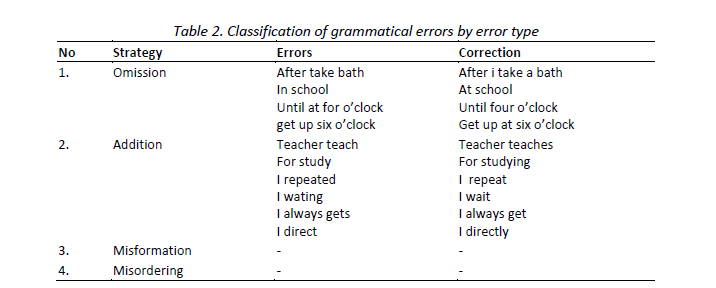
This study investigates grammatical errors in writing daily composition texts among eleventh-grade students at MA Al-Falah. The research addresses two main questions: the types of grammatical errors that occur in students’ compositions on daily activities and the most dominant type of error. Grammatical accuracy is an essential aspect of writing proficiency, yet many students struggle to produce error-free compositions. A qualitative research design was employed, with 26 students as respondents. Data were collected through documentation of students’ written works and analyzed to identify error types based on a linguistic error taxonomy. The findings reveal four types of errors: omission, addition, misformation, and misordering. Omission errors were the most frequent, occurring in 61,76% of cases, followed by addition at 38,24%, while misformation and misordering did not appear in the data. These outcomes underscore the critical necessity for strategically structured pedagogical interventions, specifically targeting morphological omissions and syntactic additions, to substantively elevate students' academic writing proficiency and structural precision.
Downloads
References
Amir, F., Pammu, A., & Nasmilah, N. (2023). An analysis of grammatical errors in writing made by English Education students at IAIN Palopo. IDEAS: Journal on English Language Teaching and Learning, Linguistics and Literature, 11(1), 720–737. https://doi.org/10.24256/ideas.v11i1.3811
Ary, D. (2020). Introduction to research in education (10th ed.). Cengage Learning.
Asenahabi, B. M. (2019). Basics of research design: A guide to selecting appropriate research design. International Journal of Contemporary Applied Researches, 6(5), 76–88.
Astiantih, S., & Akfan, S. S. (2023). Utilizing concept maps to enhance students’ writing skills. Journal of Languages and Language Teaching, 11(3), 433–446. https://doi.org/10.33394/jollt.v11i3.7993
Berger, J., Rocklage, M. D., & Packard, G. (2022). Expression modalities: How speaking versus writing shapes word of mouth. Journal of Consumer Research, 49(3), 389–408. https://doi.org/10.1093/jcr/ucab076
Çelik, F., & Eren, Z. (2023). Taking Advantage of L2 Errors in EFL Learners’ Written Language Production. Mextesol Journal, 47(4), 1–11. https://doi.org/10.61871/mj.v47n4-3
Creswell, J. W. (2014). Research design: Qualitative, quantitative, and mixed methods approaches (4th ed.). SAGE Publications.
Dulay, H., Burt, M., & Krashen, S. (1982). Language two. Oxford University Press.
Etikan, I., Musa, S. A., & Alkassim, R. S. (2016). Comparison of convenience sampling and purposive sampling. American Journal of Theoretical and Applied Statistics, 5(1), 1–4. https://doi.org/10.11648/j.ajtas.20160501.11
Fajarina, M., Bahtiar, Y., & Daristin, P. E. (2022). An error analysis in writing thesis abstract of English department. E-LINK JOURNAL, 9(2), 125. https://doi.org/10.30736/ej.v9i2.718
Gebremariam, H. T. (2024). Exploring the Effects of Written Corrective Feedback Types on Grammatical Accuracy in L2 Writing: Evidence From Ethiopian High School Students. Sage Open, 14(3), 21582440241274331. https://doi.org/10.1177/21582440241274331
Hasan, I., & Munandar, A. (2022). Grammatical errors produced by UGM English department students. Lexicon, 5(2), 107–113. https://doi.org/10.22146/lexicon.v5i2.41305
Islam, S., & Mufidah, P. N. (2021). An analysis of grammatical error on students’ writing. International Journal of English Education and Linguistics (IJoEEL), 4(1), 1–13. https://doi.org/10.33650/ijoeel.v4i1.3826
Lumban Gaol, L. N., Sembiring, Y. B., & Br Sembiring, E. M. (2025). An analysis of students’ grammatical errors in writing descriptive texts at senior high school level. Teaching English and Language Learning English Journal, 5(2).
Ly, C. K. (2020). The importance of grammar in language teaching and learning. Workshop on Innovation in Language Teaching and Learning, 186–195. https://doi.org/10.2139/ssrn.4897169
Merriam, S. B., & Tisdell, E. J. (2016). Qualitative research: A guide to design and implementation (4th ed.). Jossey-Bass.
Miles, M. B., Huberman, A. M., & Saldaña, J. (2014). Qualitative data analysis: A methods sourcebook (3rd ed.). Sage Publications.
Patton, M. Q. (2015). Qualitative research & evaluation methods: Integrating theory and practice (4th ed.). Sage Publications.
Setyorini, T. J., Dewi, P., & Masykuri, E. S. (2020). The grammatical error analysis found in students’ composition. Lensa: Kajian Kebahasaan, Kesusastraan, Dan Budaya, 10(2), 93–106. https://doi.org/10.26714/lensa.10.2.2020.93-106
Sholehah, A. J., Listyowati, R., Hanna, I. D., & Madura, U. I. (2023). An error analysis on subject -verb agreement in narrative writing text made by Senior high school students. 10.
Yunanda, F., Sinaga, P. A., Siahaan, M. P., Ginting, R. P., & Lubis, B. N. A. (2023). Grammatical errors in writing descriptive text made by tenth graders of SMA Swasta Free Methodist Medan. Jurnal Basataka, 5(2), 191–199. https://doi.org/10.36277/basataka.v5i2.175
Downloads
Published
How to Cite
Issue
Section
License
Copyright (c) 2026 Ina Daril Hanna Ina Daril Hanna, Khairiyatur Romdlanah

This work is licensed under a Creative Commons Attribution 4.0 International License.