The Effectiveness of Using Blended Learning Model in Teaching Speaking
DOI:
https://doi.org/10.30736/ej.v13i1.1356Keywords:
effectiveness, blended learning, teaching speakingAbstract
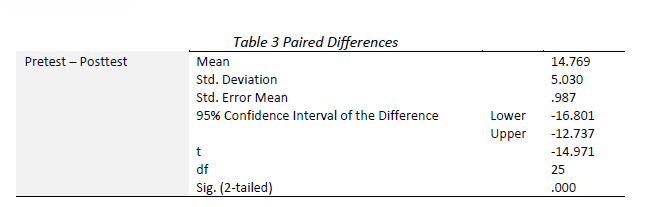
his study was conducted to examine and describe the role of implementing A La Carte model within blended learning in speaking instruction. Blended learning refers to an instructional approach that integrates conventional face-to-face teaching with technology-supported learning activities that can be carried out through both online and offline platforms. The study employed a pre-experimental research design involving a single experimental class as the main subject of observation. The participants consisted of 26 tenth-grade students of SMA NU Centini, Laren, Lamongan. Data were collected using several instruments, namely observation, interviews, and speaking tests. The collected data were subsequently analyzed using the SPSS statistical program to determine the effectiveness of A La Carte blended learning model in improving students’ speaking ability. The findings from the t-test analysis indicated that the significance value was 0.000, which was lower than the significance threshold of 0.05 (0.000 < 0.05). In addition, descriptive analysis revealed an increase in students’ performance, where the average pre-test score was 53.38 and improved to 68.15 in the post-test. Based on these results, the alternative hypothesis (Ha) was accepted, indicating that the implementation of A La Carte blended learning model had a statistically significant effect on enhancing students’ speaking skills.
Downloads
References
Al Halim, M. L. (2019). Increasing English Achievement Through Two Stay-Two Stray (Ts-Ts) Method. Karangan: Jurnal Bidang Kependidikan, Pembelajaran, Dan Pengembangan, 1(02), 102–109.
Amiti, F. (2020). Synchronous and asynchronous E-learning. European Journal of Open Education and E-Learning Studies, 5(2).
Alrayah, H. (2018). The Effectiveness of Cooperative Learning Activities in Enhancing EFL Learners’ Fluency. English Language Teaching, 11(4), 21–31.
Alshehri, A. (2018). The Effects of Roundtable Consensus, a Kagan Cooperative Learning Structure, on the Social and Task Engagement of Students with or at Risk of Disabilities with Low Social Profiles and their Typical Peers with High Social Profiles. State University of New York at Buffalo.
Ayu, M. (2020). Online learning: Leading e-learning at higher education. The Journal of English Literacy Education: The Teaching and Learning of English as a Foreign Language, 7(1), 47–54.
Brown, H. D., & Abeywickrama, P. (2004). Language assessment. Principles and Classroom Practices. White Plains, NY: Pearson Education.
Christensen, C. M., Horn, M. B., & Staker, H. (2013). Is K-12 Blended Learning Disruptive? An Introduction to the Theory of Hybrids. Clayton Christensen Institute for Disruptive Innovation.
Cole, J., & Feng, J. (2015). Effective Strategies for Improving Writing Skills of Elementary English Language Learners. Online Submission.
Dangwal, K. L. (2017). Blended learning: An innovative approach. Universal Journal of Educational Research, 5(1), 129–136.
Faraj, A. K. A. (2015). Scaffolding EFL Students’ Writing through the Writing Process Approach. Journal of Education and Practice, 6(13), 131–141.
Fareed, M., Ashraf, A., & Bilal, M. (2016). ESL learners’ writing skills: Problems, factors and suggestions. Journal of Education and Social Sciences, 4(2), 81–92.
Ferris, D. R., & Hedgcock, J. S. (2023). Teaching L2 composition: Purpose, process, and practice. Routledge.
Gunawan, C. (2018). Mahir Menguasai SPSS (Mudah Mengolah Data Dengan IBM SPSS Statistic 25). Deepublish.
Horn, M. B., & Staker, H. (2017). Blended: Using disruptive innovation to improve schools. John Wiley & Sons.
Hrastinski, S. (2019). What do we mean by blended learning? TechTrends, 63(5), 564–569.
Lane, S. (2016). Developing employability skills by using blended learning. American Journal of Educational Research, 4(1), 47–53.
Lim, F. P. (2017). An analysis of synchronous and asynchronous communication tools in e-learning. Advanced Science and Technology Letters, 143(46), 230–234.
Mardiah, H. (2020). The use of e-learning to teach English in the time of the Covid-19 pandemic. English Teaching and Linguistics Journal (ETLiJ), 1(2), 45–55.
Moubayed, A., Injadat, M., Nassif, A. B., Lutfiyya, H., & Shami, A. (2018). E-learning: Challenges and research opportunities using machine learning & data analytics. IEEE Access, 6, 39117–39138.
Noprianto, E. (2017). Student’s Descriptive text writing in SFL perspectives. IJELTAL (Indonesian Journal of English Language Teaching and Applied Linguistics), 2(1), 65–81.
Roselli, N. D. (2016). Collaborative Learning: Theoretical Foundations and Applicable Strategies to University. Journal of Educational Psychology-Propositos y Representaciones, 4(1), 251–280.
Shahabadi, M. M., & Uplane, M. (2015). Synchronous and asynchronous e-learning styles and academic performance of e-learners. Procedia-Social and Behavioral Sciences, 176, 129–138.
Sinaga, M. (2017). The Effect of Roundtable and Clustering Teaching Techniques and Students’ Personal Traits on Students’ Achievement in Descriptive Writing. Advances in Language and Literary Studies, 8(6), 69–75.
Singh, J., Steele, K., & Singh, L. (2021). Combining the best of online and face-to-face learning: Hybrid and blended learning approach for COVID-19, post vaccine, & post-pandemic world. Journal of Educational Technology Systems, 50(2), 140–171.
Taha, W. A., & Majeed, N. T. (2023). Writing English Composition and Roundtable Teaching Technique. Journal of Language Studies, 6(3, 2), 42–55.
Tayebinik, M., & Puteh, M. (2013). Blended Learning or E-learning? ArXiv Preprint ArXiv:1306.4085.
Downloads
Published
How to Cite
Issue
Section
License
Copyright (c) 2026 Muhammad Ainul Yaqin

This work is licensed under a Creative Commons Attribution 4.0 International License.