The Role of Collaboration Between schools and Industry in enhancing The Relevance of English language Instruction in PPLG Department at SMK Negeri 1 Bangil
DOI:
https://doi.org/10.30736/ej.v13i1.1373Keywords:
school-industry collaboration, vocational English, ESP, PPLG, vocational high schoolAbstract
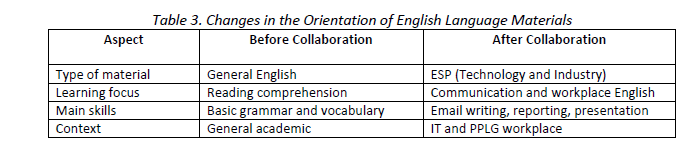
This study investigates the role of collaboration between schools and industry in enhancing the relevance of English language instruction in the Software and Game Development (PPLG) Department at SMK Negeri 1 Bangil. Despite the growing demand for English for Specific Purposes (ESP) competencies in the technology sector, previous studies have largely focused on vocational curriculum alignment and workplace readiness without specifically examining how school-industry collaboration shapes English language instruction in vocational technology programs. This research addresses this gap by exploring the integration of industry needs into English learning practices within the PPLG context. The study employs a qualitative case study design supported by quantitative descriptive data to strengthen the interpretation of findings. Data were collected through in-depth interviews, participant observation, documentation analysis, and student questionnaires involving English teachers, productive subject teachers, industry representatives, school management, and students. Data were analysed using the interactive model of Miles, Huberman, and Saldaña, while quantitative findings were used to complement and validate qualitative interpretations. The findings reveal that school-industry collaboration is implemented through industry-informed curriculum development, internship programs, guest lectures, and project-based learning activities. Quantitative data indicate that 84% of students perceive English instruction as more relevant and aligned with workplace communication needs after the implementation of collaborative programs. Qualitative findings further demonstrate improvements in students’ professional email writing, technical documentation, presentation skills, and contextual understanding of industry communication practices. However, challenges remain, including limited teacher time for curriculum adaptation, differing stakeholder perspectives, and dependence on specific industry partners.
Downloads
References
Agbevivi, S. L. G., & Acquaye, V. N. A. (2024). Teaching internship programme’s impact on English language teaching skills: Evidence from student-teachers in Ghana’s universities and colleges of education. British Journal of English Linguistics, 12(3), 57–71. https://doi.org/10.37745/bjel.2013/vol12n35771
Arfandi, A., Lopa, A. T., & Hasbi. (2024). Are vocational school students ready to face workforce disruption in the construction field? Jurnal PenSil, 13(2), 222–232. https://doi.org/10.21009/jpensil.v13i2.44379
Aryawan, F. N. (2023). Overcoming the challenges of vocational education in Indonesian SMK: Ideas on curriculum improvement, teaching quality, and English language teaching. Journal of Practice Learning and Educational Development, 3(3), 243–252. https://doi.org/10.58737/jpled.v3i3.226
Cahyani, F., & Priastuti, D. N. (2025). Industry and academic collaboration in English language learning according to the latest curriculum. Jurnal Pengabdian Masyarakat dan Riset Pendidikan, 3(4), 2528–2537. https://doi.org/10.31004/jerkin.v3i4.767
Hanapiah, J., Muljanto, S., & Setiawati, P. (2026). Implementing English for specific purposes (ESP) in a multi-major vocational context: A qualitative case study of software engineering and electrical installation programs. Journal of English Language and Education, 11(2). https://doi.org/10.31004/jele.v11i2.2216
Hiim, H. (2022). How can collaboration between schools and workplaces contribute to relevant vocational education? Vocations and Learning, 16(1), 1–21. https://doi.org/10.1007/s12186-022-09300-z
Isnavira, S., & Sujannah, W. D. (2023). Vocational High School Students' Perception on the Use of Task-Based Learning (TBL) in Speaking Class. E-Link Journal, 10(1), 1–17. DOI: https://doi.org/10.30736/ej.v10i1.768
Downloads
Published
How to Cite
Issue
Section
License
Copyright (c) 2026 zakiya isnani, Novi Rina Dewi

This work is licensed under a Creative Commons Attribution 4.0 International License.