The Effect of Randomized Topic-Based Tasks Using Flipped Bottle Media on EFL Students’ Speaking Fluency
English
DOI:
https://doi.org/10.30736/ej.v13i1.1397Keywords:
speaking fluency, randomized speaking tasks, flipped bottle media, EFL ClassroomAbstract
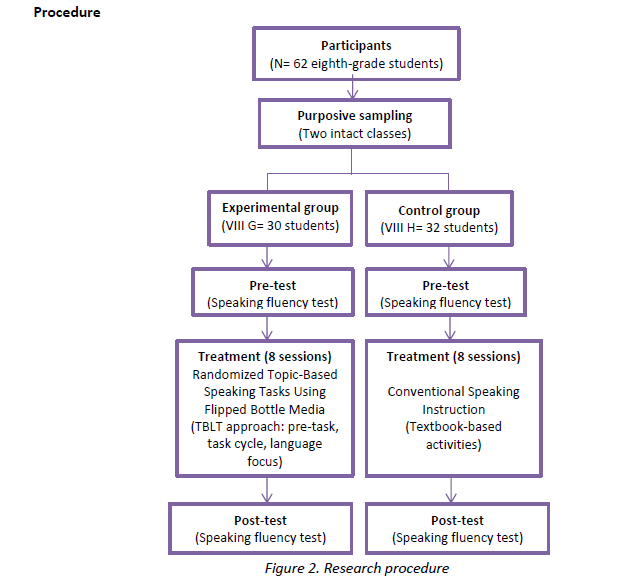
Speaking fluency become a major obstacle for students in English as a foreign language (EFL) classrooms due to limited opportunities to communicate spontaneously. This research aimed to find out the effect of randomized topic-based speaking tasks to improve students’ speaking fluency. The study employed a quasi-experimental pretest-posttest non-equivalent control group design involving 62 eighth-grade students aged 13-14 years old from a middle school in Malang. An experimental group participated in randomized topic-based speaking tasks activities using flipped bottle media, and the control group learned with the usual textbook method. Data came from speaking tests and assessed using a fluency scoring rubric followed by Brown’s (2004) criteria for speaking. The findings showed that the experimental class obtained a better post-test mean score (M= 58.83) compared the control class (M= 43.13). Furthermore, the Mann-Whitney U test make a significant difference for both groups (p= .001), indicating that the treatment positively affected students’ speaking performance. These findings suggest that flipped bottle media can serve as an effective pedagogical tool by providing randomized speaking topics that encourage spontaneous language production and meaningful classroom interaction. Therefore, integrating simple physical game media into task-based speaking activities may offer a practical alternative for improving speaking fluency, particularly in EFL classrooms with limited technological resources.
Downloads
References
Adzani, F. N., Marhum, M., Dewi, A. K., & Arid, M. (2024). Implementing task-based learning (TBL) to develop speaking skill. Pulchra Lingua: A Journal of Language Study, Literature, & Linguistics, 3(2), 97–109. https://doi.org/10.58989/plj.v3i2.41
Afria, N., Rozimela, Y., & Ratmanida. (2019). The influence of task-based language teaching on speaking skill of EFL students with intrinsic motivation. International Journal of Literature and Arts, 7(6), 179–184. https://doi.org/10.11648/j.ijla.20190706.18
Alfiani, K., Kamaruddin, A., Lebagi, D., & Mawardin. (2025). Developing speaking skill of Grade X students of senior high school in Palu through monologue technique. IDEAS: Journal of Language Teaching and Learning, Linguistics and Literature, 13(2), 3561–3574. https://doi.org/10.24256/ideas.v13i2.5628
Aqila, A. P. (2025). TBLT strategies on students’ speaking achievement: An experimental study. JET (Journal of English Teaching), 11(2), 185–197. https://doi.org/10.33541/jet.v11i2.6911
Azman, A. S. B., Fauzi, N. F. M., & Rahman, S. F. A. (2023). Benefits of task-based language teaching method in developing ESL students’ speaking skills. International Journal of Academic Research in Business and Social Sciences, 13(8), 88–96. https://doi.org/10.6007/IJARBSS/v13-i8/17347
Brown, H. D. (2001). Teaching by principles: An interactive approach to language pedagogy. Longman.
De Jong, N. H. (2023). Assessing second language speaking proficiency. Annual Review of Linguistics, 9, 541–560. https://doi.org/10.1146/annurev-linguistics-030521-052114
Diah, I. (2025). Enhancing students’ speaking skills through board games as interactive learning media in English classes. Journal Compound, 13(3), 16–23. https://doi.org/10.37304/jcp.v13i1.10763
Fikry, M. A., & Zuraida. (2025). Assessing the impact of peer interaction on the English speaking proficiency of the second semester students of English Education Study Program at the Faculty of Teacher Training and Education, Sriwijaya University. JSSR: Jurnal Sains Student Research, 3(6), 650–662. https://doi.org/10.61722/jssr.v3i6.6779
Hadi, F., & Darmawan, A. A. (2022). The implementation of virtual board games in teaching speaking to undergraduate students. In Proceedings of the 67th TEFLIN International Virtual Conference & the 9th ICOELT 2021 (TEFLIN ICOELT 2021) (Vol. 624, pp. 282–285). Atlantis Press. https://doi.org/10.2991/assehr.k.220201.050
Ho, P. V. P., Thien, N. M., An, N. T. M., & Vy, N. N. H. (2020). The effects of using games on EFL students’ speaking performances. International Journal of English Linguistics, 10(1), 183–193. https://doi.org/10.5539/ijel.v10n1p183
Isnavira, S., & Sujannah, W. D. (2023). Vocational high school students’ perceptions on the use of task-based learning (TBL) in speaking class. E-Link Journal, 10(1), 1–17. https://doi.org/10.30736/ej.v10i1.768
Jocuns, K. F. (2021). Dialogic teaching as a way to promote students’ English language use in EFL classroom. PASAA, 62(1), 173–203. https://doi.org/10.58837/chula.pasaa.62.1.7
Khowatim, L. K., Farid, A., & Saifuddin, M. (2022). The effectiveness of using communicative language teaching (CLT) on students’ speaking skill. Journal of Research in Foreign Language Teaching, 3(2), 39–48. https://doi.org/10.26594/jrflt.v3i2.3310
Li, X., & Hu, W. (2024). Peer versus teacher corrections through electronic learning communities and face-to-face classroom interactions and EFL learners’ passion for learning, speaking fluency, and accuracy. Heliyon, 10(4), e25849. https://doi.org/10.1016/j.heliyon.2024.e25849
Majidha, A., Aquariza, N. R., Afandi, M. D., & Saputri, T. (2025). The use of flipped classroom in teaching English speaking for senior high school students. E-Link Journal, 12(2), 204–210. https://doi.org/10.30736/ej.v12i2.1270
Malihah, N. (2010). The effectiveness of speaking instruction through task-based language teaching. Register Journal, 3(1), 85–101. https://doi.org/10.18326/rgt.v3i1.85-101
Munawarah, S., Hayati, S., Fitriyani, W., Rahman, E., Mieyrandha, M., Maharani, L. M., Tegar, J., & Fauzi, I. (2024). Games in enhancing productive skills for EFL students. Ebony: Journal of English Language Teaching, Linguistics, and Literature, 4(2), 138–147. https://doi.org/10.37304/ebony.v4i2.14032
Nggawu, L. O., & Thao, N. T. P. (2023). The impact of communicative language teaching (CLT) approach on students’ speaking ability in a public Indonesian university: Comparison between introvert and extrovert groups. International Journal of Language Education, 7(3), 393–413. https://doi.org/10.26858/ijole.v7i3.50617
Nuriyanti, I. (2025). Teaching English through gaming to increase students’ speaking skill at junior high school. Pubmedia Jurnal Pendidikan Bahasa Inggris, 2(4), 1–9. https://doi.org/10.47134/jpbi.v2i4.1795
Nurrona, R. S., Lutviana, R., Purnawati, M., & Sriwulandari, N. (2024). Students’ perceptions on using extending concept through language activities to improve students’ reading comprehension skill. E-Link Journal, 11(2), 131–143. https://doi.org/10.30736/ej.v11i2.1124
White, H., & Sabarwal, S. (2014). Experimental design and methods. Methodological Briefs: Impact Evaluation No. 8, UNICEF Office of Research.
Willis, J. (1996). A framework for task-based learning. Longman.
Yulianingsih, F., Dollah, S., & Amin, F. M. (2025). Student voices: Exploring learners’ perception of question game to improve speaking skills in an Indonesian EFL classroom. International Journal of Business, English, and Communication, 3(4), 192–197. https://doi.org/10.26858/ijobec.v3i4.9542
Zakaria, A., & Zakaria, N. Y. K. (2025). The impact of digital game-based learning tools on motivation, engagement, and performance in language education: A systematic literature review. International Journal of Academic Research in Progressive Education and Development, 14(1), 2235–2251. https://doi.org/10.6007/IJARPED/v14-i1/24954
Downloads
Published
How to Cite
Issue
Section
License
Copyright (c) 2026 Silvanessa Radjah, Rizky Lutviana, Oktavia Widiastuti

This work is licensed under a Creative Commons Attribution 4.0 International License.