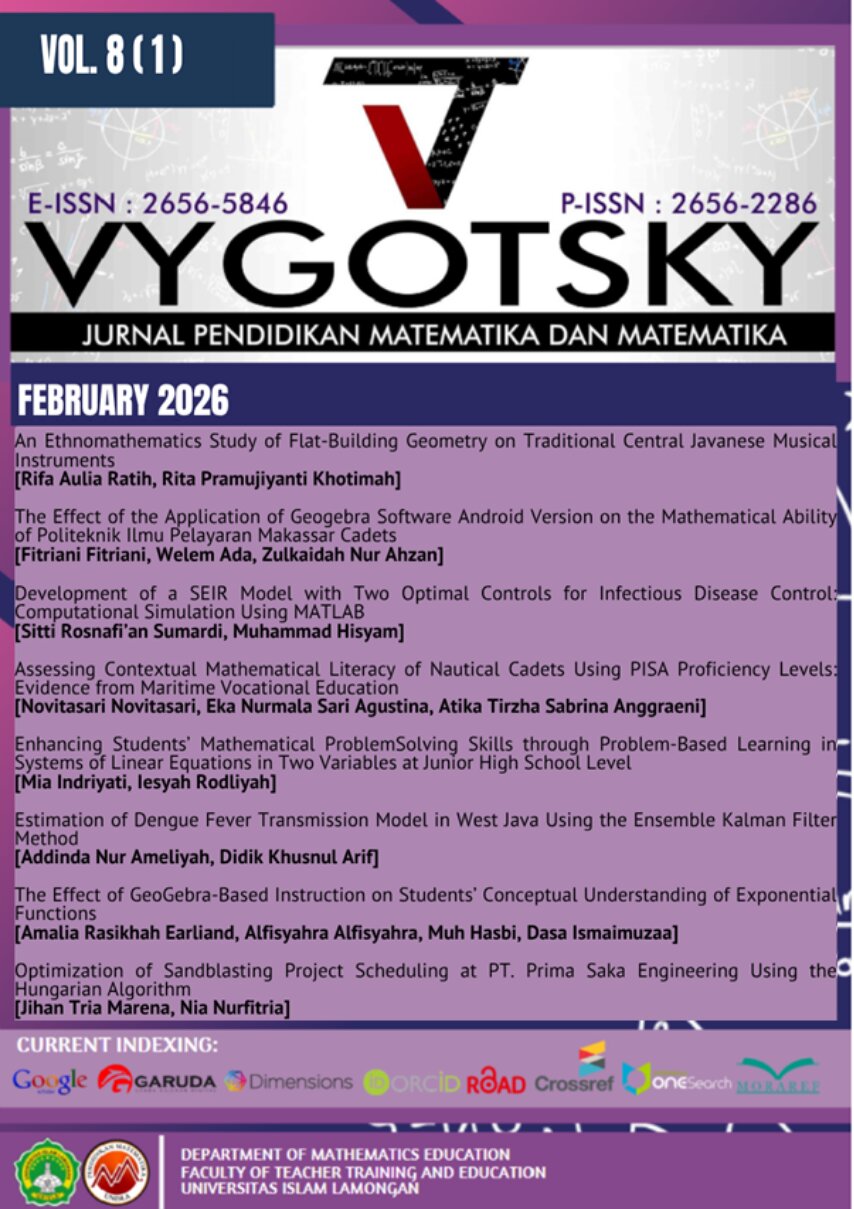
Enhancing Students’ Mathematical Problem-Solving Skills through Problem-Based Learning in Systems of Linear Equations in Two Variables at Junior High School Level
DOI:
https://doi.org/10.30736/voj.v8i1.1322Keywords:
Problem-Based Learning, Mathematical Problem-Solving Skills, Systems of Linear EquationsAbstract
This study investigated the effect of Problem-Based Learning (PBL) on students’ mathematical problem-solving skills in Systems of Linear Equations in Two Variables (SPLDV), a contextual algebra topic that has received limited empirical attention in Indonesian junior high schools. Using a posttest-only control group design, the study involved 63 Grade VIII students of State Junior High School 2 Ngoro. The experimental group learned through PBL, while the control group received conventional instruction. The experimental group achieved a significantly higher posttest mean (78.12) than the control group (p < 0.05). The effect size (Hedges’ g = 1.14) indicated a very high effect, suggesting that PBL is particularly effective for improving students’ problem-solving skills in contextual SPLDV learning.
Downloads
References
Abdullah, A., & Munawwaroh, F. (2024). Problem Based Learning Untuk Meningkatkan Keterampilan Berpikir Kritis Siswa. Jurnal Educatio, 10(1), 155–162. https://doi.org/10.31949/educatio.v10i1.6313
Arfiani, V., & Rismen, S. (2025). Penerapan Model Problem Based Learning ( PBL ) terhadap Kemampuan Pemecahan Masalah Matematis Peserta Didik Kelas VIII SMP. Jurnal Pendidikan Matematika, 9(September), 61–75.
Becker, G. S. (1993). Human Capital: A Theoretical and Empirical Analysis, with Special Reference to Education. University of Chicago Press.
Cuong, L. M., & Tien-Trung, N. (2025). Mathematics Problem-Solving Research in High School Education: Trends and Insights from the Scopus Database. European Journal of Science and Mathematics Education, 13(2), 77–89. https://doi.org/10.30935/scimath/16038
Fitriani, E., Suryadi, D., & Darhim. (2022). Enhancing Students’ Mathematical Problem-Solving Skills through Problem-Based Learning. International Journal of Instruction, 15(2), 779–796. https://doi.org/10.29333/iji.2022.15242a
Gholami, M., Kordestani-Moghadam, P., Hosseini, H. M., & Ghodrati, A. (2021). The Impact of Problem-Based Learning on Students’ Critical Thinking and Problem-Solving Skills. Thinking Skills and Creativity, 42. https://doi.org/10.1016/j.tsc.2021.100929
Hanifah, A. I., Elvierayani, R. R., & Masruroh, M. (2023). Analisis Kemampuan Pemecahan Masalah Mahasiswa dalam Menyelesaikan Soal SPL dengan Metode Gauss Jordan. Seminar Nasional LPPM UMMAT, 408–413.
Hattie, J. (2020). Visible Learning Effect Sizes When Schools Are Closed. Educational Research Review, 30. https://doi.org/10.1016/j.edurev.2020.100336
Hermawan, D. K. dan I. P. S. M. H., & Siliwangi, I. K. dan I. P. (2024). Pengaruh Model problem based learning terhadap Kemampuan Pemecahan Masalah Matematis dan self efficacy peserta didik smp kelas VII. Fibonacci: Jurnal Pendidikan Matematika dan Matematika,10(1). https://doi.org/10.24853/fbc.10.1.131-140
Hmelo-Silver, C. E. (2020). Problem-Based Learning: Core Concepts and Design Principles. Educational Psychology Review, 32(3). https://doi.org/10.1007/s10648-020-09523-1
Kappassova, S., Abylkassymova, A., & Bulut, U. (2025). Mathematical Literacy and Its Influencing Factors: A Decade of Research Findings. Eurasia Journal of Mathematics, Science and Technology Education, 21(7). https://doi.org/10.29333/ejmste/16615
Major, T., & Mulvihill, T. M. (2018). Problem-based learning pedagogies in teacher education: The case of Botswana. Interdisciplinary Journal of Problem-Based Learning, 12(1). https://doi.org/10.7771/1541-5015.1543
Mardliyah, S., Herman, T., & Febrianti, E. D. (2024). Analisis Kemampuan Berpikir Kritis Matematis Siswa SMP Kelas VIII. Teorema: Teori dan Riset Matematika, 09(01), 121–132. http://dx.doi.org/10.25157/teorema.v9i1.13312
OECD. (2018). The Future of Education and Skills: Education 2030. OECD Publishing.
Ozer, M., & Sezer, R. (2021). The Effect of Problem-Based Learning on Students’ Achievement and Problem-Solving Skills in Mathematics. Education and Information Technologies, 26, 2561–2579. https://doi.org/10.1007/s10639-021-10462-0
Polya, G. (1973). How to Solve It. Princeton University Press.
Sari, R. C. K., Febriyanti, R., & Ilmayasinta, N. (2025). Efektivitas Pendekatan Open-Ended terhadap Hasil Belajar pada Materi Kubus dan Balok. Buana Matematika: Jurnal Ilmiah Matematika dan Pendidikan Matematika, 15(1), 9-22.
Sumiati, A., & Agustini, Y. (2020). Analisis Kesulitan Menyelesaikan Soal Segi Empat dan Segitiga Siswa SMP Kelas VIII di Cianjur. Jurnal Cendekia: Jurnal Pendidikan Matematika, 04(01), 321–330. https://doi.org/10.31004/cendekia.v4i1.184
Sungur, S., & Tekkaya, C. (2021). Effects of Problem-Based Learning on Meaningful Learning and Conceptual Understanding. Learning and Instruction, 72. https://doi.org/10.1016/j.learninstruc.2020.101435
Tamur, M., Juandi, D., & Kusumah, Y. S. (2020). Effect size estimation of mathematics education research in Indonesia: A meta-analysis study. International Journal of Instruction, 13(4), 867–884. https://doi.org/10.29333/iji.2020.13453a
Tarhan, L., & Ayyildiz, Y. (2020). Problem-Based Learning in Science Education: A Meta-Analysis Study. Research in Science Education, 50, 2251–2271. https://doi.org/10.1007/s11165-018-9775-7
Trilling, B., & Fadel, C. (2009). 21st Century Skills: Learning for Life in Our Times. Jossey-Bass.
Zohar, A., & Dori, Y. J. (2003). Higher Order Thinking Skills and Low-Achieving Students. Thinking Skills and Creativity, 1(1), 37–47. https://doi.org/10.1016/S1871-1871(03)00015-5
Zulkarnain, I. (2023). Pengaruh Model Pembelajaran Problem Based Learning terhadap Kemampuan Pemecahan Masalah Matematika. Jurnal Pendidikan Matematika, 4(1), 149–157. https://doi.org/10.53624/ptk.v4i1.298
Downloads
Published
How to Cite
Issue
Section
License
Copyright (c) 2026 mia indriyati, Iesyah Rodliyah

This work is licensed under a Creative Commons Attribution-NonCommercial-ShareAlike 4.0 International License.
Copyright:
Authors who publish their manuscripts in this Journal agree to the following conditions:
- Copyright of any article on Vygotsky: Jurnal Pendidikan Matematika dan Matematika is held solely by the author under the Creative Commons Attribution 4.0 International license (CC BY NC SA).
- Authors can submit papers separately, arrange non-exclusive distribution of manuscripts that have been published in this journal into other versions (e.g. sending to the author's institutional repository, publication in a book, etc.) by acknowledging that the manuscript has been published for the first time in Vygotsky: Jurnal Pendidikan Matematika dan Matematika.
License:
Vygotsky: Jurnal Pendidikan Matematika dan Matematika is published under the terms of the Creative Commons Attribution 4.0 International License (CC BY NC SA). This license permits anyone to copy and redistribute this material in any form or format, compile, modify and develop this material for any purpose as long as it is not for commercial purposes. Additionally, anyone must provide credit and distribute contributions under the license of the creator of the original work.