Integrating SDG‑Themed Digital Authentic Texts in Communicative Language Teaching for Developing Students’ Digital Literacy
DOI:
https://doi.org/10.30736/ej.v13i1.1420Keywords:
SDGs, CLT, Digital Authentic Text, Multimodality, Literacy DigitalAbstract
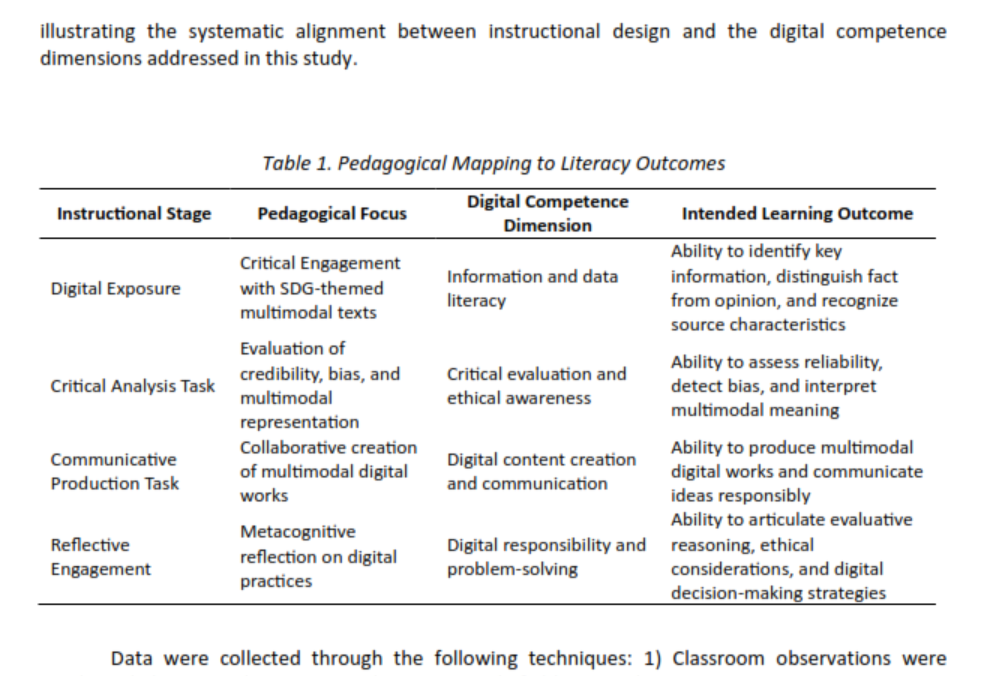
As higher education increasingly prioritizes digital competence, pedagogical models must move beyond tool integration toward design-driven digital literacy development. This study examines how embedding Sustainable Development Goal (SDG)-themed digital authentic texts within a Communicative Language Teaching (CLT) framework facilitates digital competence in a technology-enhanced university classroom. Accordingly, this study was conducted to find How does the integration of SDG-themed digital authentic texts within a CLT framework facilitate the development of undergraduate students’ digital literacy. Using a descriptive qualitative design, the study was conducted over a ten-week instructional intervention involving 28 undergraduate English Language Education students. Data were generated from classroom observations, multimodal digital works, reflective journals, and semi-structured interviews. The analysis was informed by digital competence dimensions framed by UNESCO. Findings show that SDGs functioned as epistemic and ethical substance, intensifying students’ critical engagement with multimodal digital texts. Through structured cycles of exposure, analysis, production, and reflection, students demonstrated progressive development in organized information evaluation, multimodal meaning-making, ethical digital participation, and digitally mediated communicative competence. The study developments an SDG-Embedded Techno-Pedagogical Mediation Model, arguing that digital literacy development arises from the meeting of global sustainability discourse, multimodal digital works, and communicative instructional instruments. By highlighting contextual relevance and pedagogical design as primary drivers of digital competence, this study contributes a design-oriented framework to technology-enhanced learning research.
Downloads
References
Christ, T., Arya, P., & Chiu, M. M. (2023). Digital Text/Tool Selection and Integration: What Professors Teach. Journal of Education and Learning, 12(3), 1. https://doi.org/10.5539/jel.v12n3p1
Dang Lam Ngoc, D., & Li Chong, S. (2023). Undergraduate Students’ Digital Literacy Skills in The Digital World of Sustainable Development. ICRES International Conference on Reserach in Education and Science, 677–700. www.istes.org
Georgopoulou, M. S., Troussas, C., Krouska, A., & Sgouropoulou, C. (2025). Digital Literacy in Higher Education: Examining University Students’ Competence in Online Information Practices. Computers, 14(12). https://doi.org/10.3390/computers14120528
Green, C. N. (2025). The Language and Literacy Spectrum The Language and Literacy Spectrum Strategic Considerations for Integrating Digital Technology and Strategic Considerations for Integrating Digital Technology and Literacy Learning Literacy Learning. https://digitalcommons.buffalostate.edu/lls
Hammoda, B., & Foli, S. (2024). A digital competence framework for learners (DCFL): A conceptual framework for digital literacy. Knowledge Management and E-Learning, 16(3), 477–500. https://doi.org/10.34105/j.kmel.2024.16.022
Hargreaves, H., Robin, S., & Caldwell, E. (2022). Student perceptions of reading Digital Texts for University Study. Journal of Learning Development in Higher Education, (24), 21.
Jingrui, Z., Pongpattanayothin, C., Mingmit, N., Sujarittham, T., & Jujia, C. (2025). Development of Sustainable Humanistic Education Strategies in Higher Vocational Colleges. International Education Studies, 18(2), 137. https://doi.org/10.5539/ies.v18n2p137
Joseph, G. V., Athira, P., Anit Thomas, M., Jose, D., Roy, T. V., & Prasad, M. (2024). Impact of Digital Literacy, Use of AI tools and Peer Collaboration on AI Assisted Learning: Perceptions of the University students. Digital Education Review, (45), 43–49. https://doi.org/10.1344/der.2024.45.43-49
Kayyali, M. (2024). Digital Literacy in Higher Education: Preparing Students for the Workforce of the Future. International Journal of Information Science and Computing, 11(1). https://doi.org/10.30954/2348-7437.1.2024.6
Moundy, K., Chafiq, N., & Talbi, M. (2025). Hybrid Skills: Analysis Of Digital Soft Skills Development In Students During Digital Literacy Learning Through A Digital Textbook And Flipped Classroom. Journal of Educators Online, 22(1), 12. https://ibeclatam.com/
Nagari, P. M., & Hussin, M. (2023). Critical Success Factors for Enhancing Digital Literacy Among Undergraduate Students. Pegem Journal of Education and Instruction, 13(4), 249–259. https://doi.org/10.47750/pegegog.13.04.30
Nurlina, L., Fauzan, A., Prameswari, I. G., & Saniwae, A. (2025). Digital Book with Artificial Intelligence and Augmented Reality Enriched by Indonesian Communication Culture for Foreign Students. Educational Process: International Journal, 16. https://doi.org/10.22521/edupij.2025.16.270
Puniatmaja, G. A., Parwati, N. N., Made Tegeh, I., & Sudatha, G. W. (2024). The Effect of E-learning and Students’ Digital Literacy towards Their Learning Outcomes. In Pegem Journal of Education and Instruction (Vol. 14, Number 1). https://orcid.org/0009-0003-6380-0726
Rahmah, A., & Fitriyana, E. (2024). Investigating Students’ Multimodal Literacy on Prose in Language Education Course at Billfath University. Journal of English Teaching and Learning E-LINK JOURNAL, 11(2), 153–169. https://doi.org/10.30736/ej.v11i2.1129
Santos, L. M. Dos. (2020). The discussion of communicative language teaching approach hi language classrooms. Journal of Education and E-Learning Research, 7(2), 104–109. https://doi.org/10.20448/journal.509.2020.72.104.109
Sariyatun, Sutimin, L. A., & Abidin, N. F. (2025). The Role of Social Support in Moderating the Impact of Digital Literacy and Metacognitive Skills on Self-Efficacy among Students. Educational Process: International Journal, 14. https://doi.org/10.22521/edupij.2025.14.78
Sarkar, R., Paramhans, S., Uraon, S., & Kumar Behera, G. (2025). Role of Digital Education in Promoting SDGs: Bridging the Gap in Access and Equity. International Journal of Social Impact, 10(1). https://doi.org/10.25215/2455/1001S26
Shimizu, A. Y., Havazelet, M., Smith, B. E., & Goodwin, A. P. (2025). Multimodal Analyses and Visual Models for Qualitatively Understanding Digital Reading and Writing Processes. Education Sciences, 15(9). https://doi.org/10.3390/educsci15091135
Sholeh, M. I., Abror, S., ’Azah, N., Munif, M., Shobirin, M. S., & Rohmah, L. (2026). Advancing SDG 4 through digital competence and inclusive pedagogy for equitable and sustainable education. NexusSDGs, 2(1), 2026004. https://doi.org/10.31893/sdgs.2026004
Vosoughmatin, M. (2025). Investigation of Digital Competencies and Artificial Intelligence Literacy of Special Education Students. International Journal of Modern Education Studies, 9(2). https://doi.org/10.51383/ijonmes.2025.430
Wang, H. (2025). Multimodal Digital Storytelling as Literacy Learning and Moral Cultivation Practices for University EFL Students*. Arab World English Journal, 16(1), 366–383. https://doi.org/10.24093/awej/vol16no1.23
Downloads
Published
How to Cite
Issue
Section
License
Copyright (c) 2026 Angga Prasongko, Erwin Hari Kurniawan, Ninik Farikha

This work is licensed under a Creative Commons Attribution 4.0 International License.