The Practicality of the Biolove Pocket Book as a Learning Medium for the Circulatory System Based on the Integration of Biology, Local Wisdom, and Values Science Education Students at IAIN Parepare
DOI:
https://doi.org/10.30736/seaj.v8i2.1450Keywords:
Biolove Pocket Book, Circulatory System, Practicality, Local Wisdom, Value-Oriented Learning, Science Education, Higher EducationAbstract
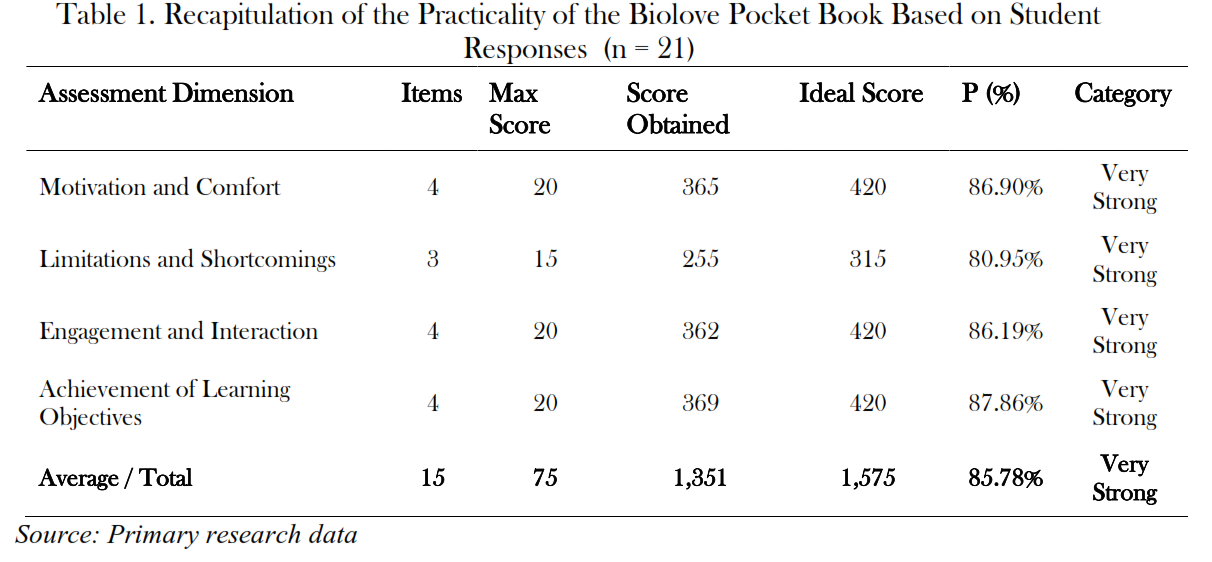
The circulatory (cardiovascular) system is considered a complex topic in undergraduate biology education, as students often harbor misconceptions and struggle to grasp the interconnected physiological mechanisms involved; consequently, there is a need for learning media that are concise, contextual, innovative, and portable, while also fostering active student engagement. This study aimed to analyze the practicality of the "Biolove Pocket Book," a printed learning resource integrating biological content, local wisdom, and value-oriented learning, based on student perceptions of its use for the circulatory system topic within the Natural Science Education (Tadris IPA) program at IAIN Parepare. A quantitative descriptive approach utilizing a survey method was employed. Data were gathered via a student response questionnaire administered to 21 students in the Natural Science Education program at IAIN Parepare after they had used the material directly during their coursework. The instrument comprised 15 Likert-scale statements covering four dimensions: (1) motivation and comfort, (2) limitations and shortcomings, (3) engagement and interaction, and (4) achievement of learning objectives. Data were analyzed using percentage calculations and practicality level categorization. The results revealed an average student response rate of 85.78%, placing the resource in the "highly practical" category. The dimension regarding the achievement of learning objectives scored the highest (87.86%), followed by motivation and comfort (86.90%), engagement and interaction (86.19%), and limitations and shortcomings (80.95%). As the data were derived from student perceptions, the findings reflect the practicality of the Biolove Pocket Book from the students' perspective rather than serving as direct evidence of the medium's effectiveness in improving learning outcomes. Given that the study was limited to 21 students from a single program, the findings are not intended for broad generalization to other higher education contexts. This study provides empirical evidence regarding the practicality of printed learning materials based on local wisdom integrating biology content, local wisdom, and value-oriented learning to teach complex biological topics in Indonesian higher education.
Downloads
References
Alenezi, M. (2023). Education Sciences Digital Learning and Digital Institution in Higher Education.
Anuyahong, B., Pucharoen, N., & Coast, G. (2023). Emerging Technologies in Learning. 18(18), 50–63.
Basari, A., Wahyudi, E., Salimi, M., Hidayah, R., & Surya, A. (2025). Local wisdom-based science e-module to improve cultural literacy and critical thinking skills of elementary school students. 3(3), 387–395. https://doi.org/10.62672/joease.
Bazhenova, E. D., Shuzhebayeva, A. I., Kuntuganova, S. M., Bazhenova, M. D., & Murygina, S. I. (n.d.). The Impact of Mobile Learning on Undergraduate Students ’ Cognitive Learning Outcomes : A Meta-Analytic Review. 42–53.
Bordes, S. J., Manyevitch, R., Huntley, J. D., Li, Y., & Murray, I. V. J. (2026). Medical student misconceptions in cardiovascular physiology. November 2020, 241–249. https://doi.org/10.1152/advan.00220.2020
Chen, C. (2023). The study on the effects of gamified interactive e-books on students ’ learning achievements and motivation in a Chinese character learning flipped classroom. August, 1–14. https://doi.org/10.3389/fpsyg.2023.1236297
Deva, A., Raghavan, D., & Arulappan, J. (2023). Heliyon Preferences for printed books versus E-books among university students in a Middle Eastern country. Heliyon, 9(6), e16776. https://doi.org/10.1016/j.heliyon.2023.e16776
Inarda, A. (2023). Promoting outcomes-based instructional materials: Testing the effectiveness of print modules for business students. 12(3), 1257–1268. https://doi.org/https://doi.org/10.12973/eu-jer.12.3.1257
Jirana, J., Firdaus, F., Damayanti, M., & Dahliana, D. (2024). Pengembangan media pembelajaran buku saku berbasis mind map pada pelajaran biologi materi virus. SAINTIFIK: Jurnal Matematika, Sains, Dan Pembelajarannya, 10, 107–114. https://doi.org/https://doi.org/10.31605/saintifik.v10i1.495
Downloads
Published
How to Cite
Issue
Section
License
Copyright (c) 2026 Novia Anugra, Musma Rukmana

This work is licensed under a Creative Commons Attribution-ShareAlike 4.0 International License.
Authors who publish with this journal agree to the following terms:
- Authors retain copyright and grant the journal right of first publication with the work simultaneously licensed under a Creative Commons Attribution-ShareAlike 4.0 International License that allows others to share the work with an acknowledgment of the work's authorship and initial publication in this journal.
- Authors are able to enter into separate, additional contractual arrangements for the non-exclusive distribution of the journal's published version of the work (e.g., post it to an institutional repository or publish it in a book), with an acknowledgment of its initial publication in this journal.
- Authors are permitted and encouraged to post their work online (e.g., in institutional repositories or on their website) prior to and during the submission process, as it can lead to productive exchanges, as well as earlier and greater citation of published work (See The Effect of Open Access).

This work is licensed under a Creative Commons Attribution-ShareAlike 4.0 International License.