Negotiating Mathematical Meaning in Digital Spaces: A Systematic Review of Paul Ernest’s Social Constructivism in Mathematics Education
DOI:
https://doi.org/10.30736/reforma.v16i1.1389Keywords:
Social Constructivism, Paul Ernest, Mathematical Meaning, Digital Learning, Systematic Literature ReviewAbstract
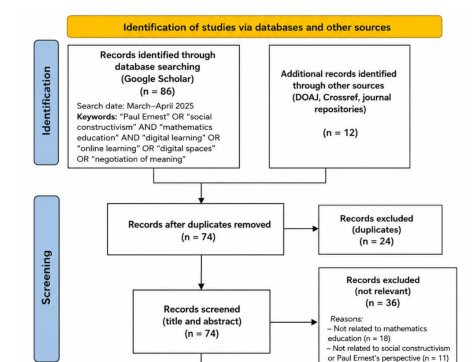
The rapid development of digital technologies has transformed mathematics education by enabling new forms of interaction, communication, and collaboration in learning environments. However, many studies still emphasize instructional strategies without explicitly examining the epistemological process through which mathematical meaning is constructed. This study aims to systematically review on Paul Ernest’s social constructivism with a specific focus on the negotiation of mathematical meaning in digital learning spaces. This study employs a systematic review design following a structured review protocol that includes formulation of research questions, systematic search of relevant literature, selection based on inclusion and exclusion criteria, quality appraisal, and thematic synthesis. A total of 28 peer reviewed studies published between 2019 and 2025 were selected from reputable databases focusing on social constructivism, digital mathematics education, and technology enhanced learning. The data were analyzed using thematic analysis to identify patterns related to epistemological foundations, meaning negotiation processes, digital learning environments, teacher student roles, and implementation challenges. The findings are organized into five key themes: epistemological foundations of social constructivism, negotiation of mathematical meaning in learning processes, digital environments as spaces for meaning construction, transformation of teacher and student roles, and challenges and opportunities in digital constructivist learning. The synthesis shows that mathematical knowledge is consistently conceptualized as socially constructed through interaction, discourse, and collaborative reasoning. The results further indicate that digital environments expand the space for mathematical meaning negotiation by enabling multimodal representations, distributed interaction, and technology mediated communication. Nevertheless, the effectiveness of these environments depends on digital literacy, pedagogical design, and interaction quality. Teachers play a crucial role as facilitators of epistemic environments, while students actively construct and validate mathematical knowledge through collaborative engagement.
Downloads
References
Amelia, A., & Nasutio, C. P. (2025). Pengaruh Media Pembelajaran Digital Terhadap Pemahaman Materi Siswa MA 2 MNodel Medan. Jurnal Multidisiplin Ilmu Akademik, 2(3), 333–342.
Azizah, N., & Hendriyani, W. (2024). Implementasi Penggunaan Teknologi Digital sebagai Media Pembelajaran Pada Pendidikan Inklusi di Indonesia. Jurnal Educatio, 10(2), 644–651. https://doi.org/https://doi.org/10.31949/educatio.v10i2.8586
Buchori, A., & Rahmawati, N. D. (2024). Design of Virtual Reality-Based Mathematics Virtual Lab with Constructivist Approach in Senior High School. International Conference On Digital Education And Social Science (ICDESS) 2024, (December), 1–7.
Bustomi, B., Sukardi, I., & Astuti, M. (2024). Pemikiran Konstruktivisme Dalam Teori Pendidikan Kognitif Jean Piaget Dan Lev Vygotsky. Jurnal Review Pendidikan Dan Pengajaran, 7(4), 16376–16383.
Chaiarwut, S., Srikoon, S., Siritaratiwat, A., & Kwangmuang, P. (2025). Social Sciences & Humanities Open Enhancing executive mathematics problem-solving through a constructivist digital learning platform : Design , development and evaluation. Social Sciences & Humanities Open, 11(January), 101338. https://doi.org/10.1016/j.ssaho.2025.101338
Engelbrecht, J., & Borba, M. C. (2024). Recent developments in using digital technology in mathematics education. ZDM - Mathematics Education, 56(2), 281–292. https://doi.org/10.1007/s11858-023-01530-2
Ernest, P. (1991). The philosophy of mathematics education. Taylor & Francis e-Library.
Ernest, P. (2019). The ethical obligations of the mathematics teacher. Journal of Pedagogical Research The, 3(1), 80–91. https://doi.org/10.33902/JPR.2019.6
Ernest, P. (2021). Mathematics , ethics and purism : an application of MacIntyre ’ s virtue theory. Synthese, 199(1), 3137–3167. https://doi.org/10.1007/s11229-020-02928-1
Ernest, P. (2023). Rejection , Disagreement , Controversy and Acceptance in Mathematical Practice : Episodes in the Social Construction of Infinity. Global Philosophy, 33(1), 1–22. https://doi.org/10.1007/s10516-023-09652-8
Fadilah, N., Mukhtar, M., & Fauzi, K. M. (2025). Studi Literatur: Pembelajaran Konstruktif Dengan Menggunakan Konten Video Interaktif Berbasis Budaya Tradisional. Jurnal PEKA (Pendidikan Matematika), 08(02), 44–57. https://doi.org/10.37150/jp.v8i2.3138.Copyright
Febindayanti, A., & Sinaga, B. (2024). Analisis pemahaman konsep matematika siswa dalam penerapan pembelajaran berbasis konstruktivisme. Indonesian Journal of Education and Learning, 8(1), 70–76. https://doi.org/10.31002/ijel.v8i1.2073
Kabul, S. N., & Kaleci, F. (2024). A Bibliometric Analysis of Studies on Sustainability in Mathematics Education Based on Web of Science Database. Journal of Teacher Education and Lifelong Learning, 6(2), 435–455. https://doi.org/10.51535/tell.1559918
Kurniawan, R., Purwanto, A., & Sumargo, B. (2025). outcomes from web-based multimedia content to enhance environmental consciousness regarding air pollution in Jakarta. Journal of Applied Research in Higher Education, 1–20. https://doi.org/10.1108/JARHE-11-2024-0612
Levin, I., Semenov, A. L., & Gorsky, M. (2025). Smart Learning in the 21st Century : Advancing Constructionism Across Three Digital Epochs. Education Science, 15(1), 1–22.
Manik, M. (2024). The Obstacles in Implementing the Independent Curriculum in Mathematics Learning: A Review from the Perspective of Social Constructivism Philosophy and Progressive Educators. International Journal on Advanced Science, Education, and Religion (IJoASER), 7(4), 114–121.
Martinez, P. H., Rogovchenko, S., Rogovchenko, Y., & Thomas, S. T. (2023). Collaboration between Mathematicians and Mathematics Educators : dialogical inquiry as a methodological tool in Mathematics Education research. Educational Studies in Mathematics, 129–148. https://doi.org/10.1007/s10649-023-10245-w
Mufti, F. I., Hakim, L. El, & Aziz, T. A. (2025). Systematic Literature Review : Penerapan Konstruktivisme Sosial dalam Pembelajaran melalui Pendekatan Realistic Mathematics Education ( RME ) berbasis Etnomatematika. Jurnal Riset Pendidikan Matematika Jakarta, 7(1), 76–85.
LESTARI, A. D. (2021). PENGEMBANGAN MEDIA PEMBELAJARAN POWER POINT INTERAKTIF PADA MATERI BANGUN DATAR KELAS IV SD/MI (Doctoral dissertation, Universitas Islam Lamongan).
Susanti, I., Santoso, A., & Hamidah, I. (2023). Edukasi Pemanfaatan Limbah Kulit Pisang sebagai Adsorben Limbah Zat Warna. Jurnal Pengabdian kepada Masyarakat Nusantara, 4(2), 1292-1297.
Rosdiana, S. R., Habibbulloh, M., Susanti, I., & Aisyurrahman, D. F. (2022, September). Empirical and Theoretical Student Worksheet Development in Vector Resultant Analysis. In Proceeding International Conference on Environment Health, Socioeconomic and Technology (Vol. 1, pp. 33-40).
Sholeha, N. A., Muthmainah, N. G., Robyano, R. A., Sophia, H., Susanti, I., & Ramadhania, N. R. (2025). Variation of Polymer Matrix On the Quality of Bioplastic from Cassava Peel Waste from Tapai Industry in Bogor. Hydrogen: Jurnal Kependidikan Kimia, 13(4), 809-828.
Rismayanti, R., Susanti, I., Wulandari, S. A., & Mahbubah, K. (2026). Keterampilan Argumentasi Ilmiah Siswa Melalui Pembelajaran Problem Based Learning Berbasis Socio Scientific Issue dengan Metode Debate Class pada Materi Pemanasan Global. Jurnal Penelitian Sains dan Pendidikan (JPSP), 6(1), 16-26.
Nadhifah, A. (2024, September). Effect Of Differentiated Learning On Science Literacy Skills Of Junior High School Students. In International Conference on Learning Community (Vol. 1, No. 1, pp. 605-612).
Wicaksono, R. R., Putri, M. S. A., Yanik, C. N. F., Hanif, M. M., & Jannah, M. (2025). PEMANFAATAN TANAMAN SANSEVIERA TRIFASCIATA LAURANTII DAN SANSEVIERA TRIFASCIATA TERHADAP AKTIVITAS PEROKOK YANG MENGURANGI KADAR COHb. Journal of Industrial Hygiene and Occupational Health, 10(1), 99-107.
Abdul Rohim, T., Velu Perumal, P., Salsabila, N., Gurendro, P., Aceng, R., Dina Keumala, S., ... & Lukman, H. (2025). Impact of xylene exposure on blood profiles and neurotoxic symptoms among printing workers in Surabaya. Journal of Medicinal and Pharmaceutical Chemistry Research, 7(8), 1763-1773.
Rosdiana, S. R., Febriyanti, R., Mahbubah, K., Rahmawati, S., & Hamidah, I. (2024). Pelatihan penyelenggara diklat bagi komunitas kerja guru di Kabupaten Lamongan. Abdimas Siliwangi, 7(3), 629-638.
Fathurrahman, F., Muhyi, A., Arifin, B., & Huda, M. (2022). The influence of school management on the implementation of the" merdeka belajar" curriculum. Al-Tanzim: Jurnal Manajemen Pendidikan Islam, 6(4), 1274-1286.
Novitasari, N., Febriyanti, R., Anjarsari, E., Prafianti, R. A., & Aishwaray, E. N. R. (2023). PENDEKATAN INKUIRI BERBASIS ETNOMATEMATIKA: ANALISIS KEMAMPUAN BERPIKIR KREATIF MATERI BANGUN DATAR. JPMI (Jurnal Pembelajaran Matematika Inovatif), 6(2), 483-496.
Sari, Y. I., & Anjarsari, E. (2023). Efektifitas Penggunaan Media Ular Tangga Terhadap Hasil Belajar Matematika. Tematik: Jurnal Konten Pendidikan Matematika, 1(1), 19-24.
Elvierayani, R. R., Hanifah, A. I., Sustyorini, E. N., & Fahruziah, N. (2024). Proses Berpikir Aljabar Mahasiswa Berdasarkan Representasional Gesture dalam Menyelesaikan Masalah. JIPM (Jurnal Ilmiah Pendidikan Matematika), 13(1), 67-78.
Oktaviana, D. L., Siswono, T. Y. E., Prastiti, T. D., & Albab, M. U. (2025). Pengembangan modul berbasis masalah berbantuan software geogebra untuk meningkatkan pemahaman konsep dan hasil belajar geometri transformasi. JIPI (Jurnal Ilmiah Penelitian dan Pembelajaran Informatika), 10(3), 2650-2658.
Huda, S., Mawaddah, S., & Elvierayani, R. R. (2022). Design of an inquiry-based mathematical literacy learning model to encourage critical thinking. DIDAKTIKA: Jurnal Pemikiran Pendidikan, 28(2), 18-28.
Angga, R. U. D., & Rajagukguk, W. (2022). Differences in Students' Mathematical Communication Ability and Self-Efficacy Between Open Ended and Contextual Learning Approach. Journal of Education and Practice, 13(7), 19-25.
Al-Wafi, M. M. M. (2024). STRATEGI KEPALA SEKOLAH DALAM MENARIK MINAT MASYARAKAT DI SDN TERGAMBANG BANCAR. Journal Educatione, 1(2).
Hanifah, A. I., & Elvierayani, R. R. (2024). Kemampuan Pemecahan Masalah Mahasiswa Dalam Menyelesaikan Masalah Aljabar Linier Ditinjau Dari Gaya Kognitif. Kadikma, 15(3), 82-90.
Rodliyah, I., & Anjarsari, E. (2025). Analisis Proses Berpikir Aljabar Mahasiswa pada Mata Kuliah Program Linear. Jurnal Axioma: Jurnal Matematika dan Pembelajaran, 10(2), 104-116.
Rosyidah, F., & Fathurrahman, F. (2025). Implementasi Supervisi Akademik dalam Meningkatkan Mutu Pembelajaran Pendidikan Agama Islam pada Guru SLB Negeri Lamongan. Autentik: Jurnal Pengembangan Pendidikan Dasar, 9(2), 361-371.
Sari, R. C. K., Febriyanti, R., & Ilmayasinta, N. (2025). Efektivitas Pendekatan Open-Ended terhadap Hasil Belajar pada Materi Kubus dan Balok. Buana Matematika: Jurnal Ilmiah Matematika dan Pendidikan Matematika, 15(1), 9-22.
Mahbubah, K., Santoso, A., Prafianti, R. A., & Rahmawati, S. (2025). Penguatan Karakter Siswa Madrasah Tsanawiyah Melalui Pembelajaran Berbasis Integrasi Sains dan Islam. Prima Abdika: Jurnal Pengabdian Masyarakat, 5(2), 335-344.
Fathurrahman, F., Amalia, N. S., & Albab, H. A. U. (2024, January). CURRICULUM INTEGRATION IMPLEMENTATION MODEL: INDEPENDENT CURRICULUM DINIYAH. In PROCEEDING OF INTERNATIONAL CONFERENCE ON EDUCATION, SOCIETY AND HUMANITY (Vol. 2, No. 1, pp. 62-69).
Wati, D. F., Ilmayasinta, N., & Prafianti, R. A. (2024, November). The Influence of A Cooperative Learning Model of Team Games Tournament (TGT) Type on Mathematic Critical Thinking Ability through A Scientific Approach to Statistical Materials. In Proceedings International Conference on Education Innovation and Social Science (pp. 52-58).
Hanifah, A. I., & Elvierayani, R. R. (2024). Kemampuan Pemecahan Masalah Mahasiswa Dalam Menyelesaikan Masalah Aljabar Linier Ditinjau Dari Gaya Kognitif. Kadikma, 15(3), 82-90.
Ambarwati, D. N., Febriyanti, R., Prafianti, R. A., & Novitasari, N. (2024, August). Exploring Students' Difficulties in Solving Mathematics Problems: High Order Thinking Problems. In The 2nd International Conference on Mathematics, its Applications, and Mathematics Education (ICMAME) 2024.
Wati, D. F., Ilmayasinta, N., & Prafianti, R. A. (2024, November). The Influence of A Cooperative Learning Model of Team Games Tournament (TGT) Type on Mathematic Critical Thinking Ability through A Scientific Approach to Statistical Materials. In Proceedings International Conference on Education Innovation and Social Science (pp. 52-58).
Elvierayani, R. R., Sa’dijah, C., Sukoriyanto, Rahardi, R., & Mustakim, S. S. (2025, March). Collaborative gestures of slow learner students in group discussions for solving mathematical problems. In AIP Conference Proceedings (Vol. 3142, No. 1, p. 020009). AIP Publishing LLC.
Amali, A., Albab, M. U., Febriyanti, R., & Novitasari. (2025, September). Curriculum paradigm: Analysis of the implementation merdeka curriculum in mathematics learning. In AIP Conference Proceedings (Vol. 3316, No. 1, p. 140015). AIP Publishing LLC.
Hendratmoko, A. F., Fauziah, A. N. M., Susiyawati, E., Astriani, D., Nurita, T., Martini, M., ... & Boey, A. (2026). Integrating ChatGPT-driven self-assessment and Debate Based on Inquiry Learning (DBOIL) to enhance students’ argumentation skills: Leveraging AI for quality science learning aligned with SDG 4. In E3S Web of Conferences (Vol. 696, p. 02005). EDP Sciences.
Septaria, K., Asrori, M., Setyo, C. Y., Faridah, F., Anam, M. K., Sukardi, S., & Kholiq, A. (2025). Pemberdayaan Guru Ma'arif melalui Pemanfaatan Deep Learning Engagement Tools untuk Peningkatan Literasi Digital dan Pedagogis. Bhakti Nusantara: Jurnal Pengabdian Kepada Masyarakat, 1(1), 25-39.
Fatharani, A., Madlazim, M., Anggaryani, M., Satriawan, M., & Septaria, K. (2026). Learning from Earthquakes: The Role of Socio-Scientific Issues in Developing Students’ Science Argumentation Skills. Prisma Sains : Jurnal Pengkajian Ilmu Dan Pembelajaran Matematika Dan IPA IKIP Mataram, 14(1), 123–143. https://doi.org/10.33394/j-ps.v14i1.16362
Sabtiawan, W. B., Sudibyo, E., Sari, D. A. P., Purnomo, A. R., Roqobih, F. D., Septaria, K., … Fauziah, I. N. (2025). Pelatihan Penerapan Asesmen dalam Implementasi Kurikulum Merdeka untuk Guru-Guru IPA. Dedikasi: Journal of Community Engagement and Empowerment, 3(2), 42–53. https://doi.org/10.58706/dedikasi.v3n2.p42-53
Septaria, K., Fatharani, A., & Baihaqi, A. (2025). Are Scrapbooks Able to Increase Tsunami Disaster Literacy? An Analytical Study of Junior High School Students Materials. SEJ (Science Education Journal), 9(2), 115-133. https://doi.org/10.21070/sej.v9i2.1656
Septaria, K., Fatharani, A., Supardi, Z. A. I., Suyono, S., & Regita, M. A. (2025). Pengembangan Sikap Ilmiah Abad 21 Melalui Lembar Kerja Berbasis Teori Pembelajaran Sosial pada Materi Listrik Statis. Jurnal Penelitian Sains dan Pendidikan (JPSP), 5(1), 65-86. https://doi.org/10.23971/jpsp.v5i1.9758
Sho'idah, Y., Septaria, K., & Wulandari, S. A. (2025). Analysis of Student Scientific Communication Based on The Development and Use of Diorama Media Using The Guided Inquiry Model. Reforma: Jurnal Pendidikan dan Pembelajaran, 15(1), 24-47. https://doi.org/10.30736/reforma.v15i1.1207
Hendratmoko, A. F., Puspitarini, S., Budiyanto, M., Rahman, N., Septaria, K., & Marpuah, S. (2025). Think-Aloud Protocol as a Method for Exploring and Understanding the Argumentation Skills of Pre-Service Science Teachers. Prisma Sains: Jurnal Pengkajian Ilmu dan Pembelajaran Matematika dan IPA IKIP Mataram, 13(2), 268-282. https://doi.org/10.33394/j-ps.v13i2.15214
Septaria, K., Fatharani, A., Dewanti, B. A., & Najawa, W. C. (2024). Designing Pirposal-learning based Module integrated with Socio-Scientific Issue to Enhance Students’ Scientific Reasoning Skill. Indonesian Journal of Mathematics and Natural Science Education, 5(2), 122-134. https://doi.org/10.35719/mass.v5i2.162
Septaria, K., Nissak, K., & Wulandari, S. A. (2023). Student Identity and Guided Inquiry Learning in Junior High School Students: A Correlation Analysis. Jurnal Penelitian Pendidikan IPA, 9(10), 8351-8358. https://doi.org/10.29303/jppipa.v9i10.4584
Septaria, K., Dewanti, B. A., & El Afidah, M. I. (2020). Development of module disaster mitigation based on STEM for secondary schools. JPPIPA (Jurnal Penelitian Pendidikan IPA), 5(2), 61-68. https://doi.org/10.26740/jppipa.v5n2.p61-68
Septaria, K. (2019). Mengeksplorasi Argumentasi dan Pengetahuan Pendidik Ilmu Pengetahuan Alam (IPA) tentang Pemanasan Global. PEDAGOGIA: Jurnal Pendidikan, 8(2), 247-256. https://doi.org/10.21070/pedagogia.v8i2.2369
Septaria, K., & Fatharani, A. (2022). Analisis Penggunaan Software PlantNet Terhadap Pemerolehan Konsep Dan Keterampilan Prosedural Siswa. Indonesian Journal of Educational Science (IJES), 5(1), 73-83. https://doi.org/10.31605/ijes.v5i1.1604
Septaria, K., Dewanti, B. A., & Habibbulloh, M. (2019). Implementasi metode pembelajaran spot capturing pada materi pemanasan global untuk meningkatkan keterampilan proses sains. Prisma Sains: Jurnal Pengkajian Ilmu dan Pembelajaran Matematika dan IPA IKIP Mataram, 7(1), 27-37. https://doi.org/10.33394/j-ps.v0i0.1379
Septaria, K., & Fatharani, A. (2022). Manga versus webtoon: Alternative science learning module based on Dr Stone. Jurnal Inovasi Pendidikan IPA, 8(1), 11-22. https://doi.org/10.21831/jipi.v8i1.43389
Septaria, K., & Haque, E. H. (2022). Upaya Peningkatan Pengetahuan Masyarakat terhadap Covid-19 Menggunakan Media Poster. TAAWUN, 2(02), 115-124.
Septaria, K., Sholihin, M., Kholiq, A., Hayati, E., & Maulana, V. I. P. (2022). Peningkatan Kualitas Pendidik dan Pembelajaran Menuju Madrasah yang Ungggul dan Berkelanjutan. Jurnal Berdaya Mandiri, 4(2), 167-181. https://doi.org/10.31316/jbm.v4i2.1742
Fatharani, A., Madlazim, M., Anggaryani, M., Satriawan, M., & Septaria, K. (2026). Learning from Earthquakes: The Role of Socio-Scientific Issues in Developing Students’ Science Argumentation Skills. Prisma Sains: Jurnal Pengkajian Ilmu dan Pembelajaran Matematika dan IPA IKIP Mataram, 14(1), 123-143.
Septaria, K., Fatharani, A., & Baihaqi, A. (2025). Are Scrapbooks Able to Increase Tsunami Disaster Literacy? An Analytical Study of Junior High School Students Materials. SEJ (Science Education Journal), 9(2), 115-133.
Downloads
Published
How to Cite
Issue
Section
License
Copyright (c) 2026 Mohammad Nurwahid, Sofia Ashar

This work is licensed under a Creative Commons Attribution-ShareAlike 4.0 International License.
Penulis yang mempublikasikan naskahnya pada Jurnal ini menyetujui ketentuan berikut:
- Hak cipta pada setiap artikel adalah milik penulis, dan penulis mengakui bahwa Reforma : Jurnal Pendidikan dan Pembelajaran berhak sebagai pihak yang mempublikasikan pertama kali dengan lisensi Attribution-ShareAlike 4.0 International (CC BY-SA 4.0).
- Lisensi ini mengizinkan setiap orang untuk:
- Berbagi — menyalin dan menyebarluaskan kembali materi ini dalam bentuk atau format apapun;
- Adaptasi — menggubah, mengubah, dan membuat turunan dari materi ini untuk kepentingan apapun, termasuk kepentingan komersial.
Berdasarkan ketentuan berikut:
- Atribusi —Mereka harus mencantumkan nama yang sesuai, mencantumkan tautan terhadap lisensi, dan menyatakan bahwa telah ada perubahan yang dilakukan. Mereka dapat melakukan hal ini dengan cara yang sesuai, namun tidak mengisyaratkan bahwa pemberi lisensi mendukung Mereka atau penggunaan Mereka.
- BerbagiSerupa — Apabila Mereka menggubah, mengubah, atau membuat turunan dari materi ini, Mereka harus menyebarluaskan kontribusi Mereka di bawah lisensi yang sama dengan materi asli.
- Tidak ada pembatasan tambahan — Mereka tidak dapat menggunakan ketentuan hukum atau sarana kontrol teknologi yang secara hukum membatasi orang lain untuk melakukan hal-hal yang diizinkan lisensi ini.
- Penulis dapat memasukan tulisan secara terpisah, mengatur distribusi non-ekskulif  dari naskah yang telah terbit di jurnal ini kedalam versi yang lain (misal: dikirim ke respository institusi penulis, publikasi kedalam buku, dll), dengan mengakui bahwa naskah telah terbit pertama kali pada Reforma : Jurnal Pendidikan dan Pembelajaran