Reconstructing Educational Philosophy as a Metatheoretical Framework for AI-Driven Educational Science
DOI:
https://doi.org/10.30736/reforma.v16i2.1418Keywords:
Educational Philosophy, Educational Science, Ontology, Epistemology, Axiology, Structure Of KnowledgeAbstract
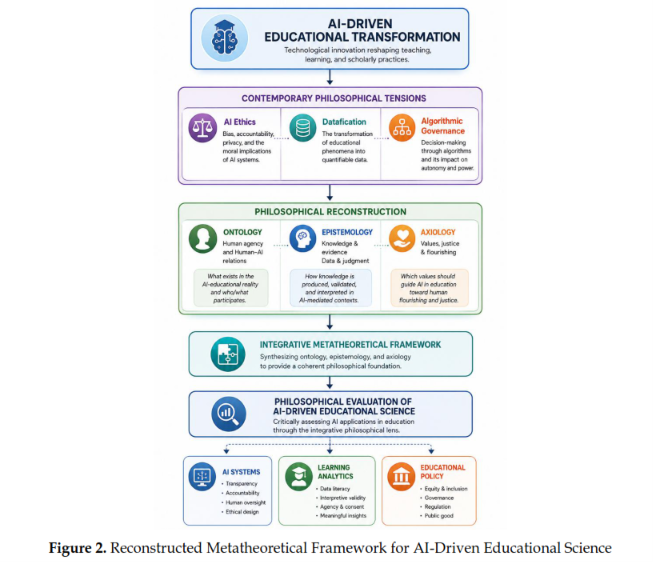
The development of educational science in the contemporary era has been increasingly influenced by empirical research, technological innovation, data-driven decision-making, and artificial intelligence. While these advancements have enhanced the effectiveness of educational practices, they have also raised concerns regarding the diminishing role of philosophical reflection in determining the meaning, purpose, and values of education. This study aims to examine the position of educational philosophy within the structure of knowledge by analyzing its ontological, epistemological, and axiological foundations and exploring its relevance to contemporary educational science. Employing a qualitative library research approach, this study analyzes classical and contemporary philosophical literature related to educational theory, scientific inquiry, and the philosophy of education. The findings reveal that educational philosophy serves as the foundational framework of educational science by defining the nature of educational reality, guiding the construction and validation of educational knowledge, and providing ethical and normative orientations for educational practice. Furthermore, the study argues that the growing dominance of technocratic and data-driven approaches in education necessitates a reconstruction of the role of educational philosophy. Rather than functioning merely as a historical or introductory discipline, educational philosophy should be repositioned as a metatheoretical foundation that integrates ontological understanding, epistemological rigor, and axiological reflection. Such a reconstruction enables educational science to maintain its scientific credibility while preserving its commitment to human development, ethical responsibility, and social transformation. The study concludes that educational philosophy remains indispensable for ensuring that educational progress is directed not only toward technological advancement but also toward the cultivation of meaningful, humane, and value-oriented educational practices.
Downloads
References
An, T., & Oliver, M. (2021). What in the world is educational technology? Rethinking the field from the perspective of the philosophy of technology. Learning, Media and Technology, 46(1), 6–19. https://doi.org/10.1080/17439884.2020.1810066
Aristotle. (2009). The Nicomachean Ethics. OUP Oxford.
Ayeni, O. O., Hamad, N. M. A., Chisom, O. N., Osawaru, B., & Adewusi, E. (n.d.). AI in education: A review of personalized learning and educational technology.
Baruwa, I. (2024). A Conversation with ChatGPT: Philosophy, Critical Thinking, and Higher Education. Journal of AI, 9(1), 1–12.
Downloads
Published
How to Cite
Issue
Section
License
Copyright (c) 2026 Sukma Eka Saputra, Ziad Ahmad Zarkasyi, Ahmad Sulthon

This work is licensed under a Creative Commons Attribution-ShareAlike 4.0 International License.
Penulis yang mempublikasikan naskahnya pada Jurnal ini menyetujui ketentuan berikut:
- Hak cipta pada setiap artikel adalah milik penulis, dan penulis mengakui bahwa Reforma : Jurnal Pendidikan dan Pembelajaran berhak sebagai pihak yang mempublikasikan pertama kali dengan lisensi Attribution-ShareAlike 4.0 International (CC BY-SA 4.0).
- Lisensi ini mengizinkan setiap orang untuk:
- Berbagi — menyalin dan menyebarluaskan kembali materi ini dalam bentuk atau format apapun;
- Adaptasi — menggubah, mengubah, dan membuat turunan dari materi ini untuk kepentingan apapun, termasuk kepentingan komersial.
Berdasarkan ketentuan berikut:
- Atribusi —Mereka harus mencantumkan nama yang sesuai, mencantumkan tautan terhadap lisensi, dan menyatakan bahwa telah ada perubahan yang dilakukan. Mereka dapat melakukan hal ini dengan cara yang sesuai, namun tidak mengisyaratkan bahwa pemberi lisensi mendukung Mereka atau penggunaan Mereka.
- BerbagiSerupa — Apabila Mereka menggubah, mengubah, atau membuat turunan dari materi ini, Mereka harus menyebarluaskan kontribusi Mereka di bawah lisensi yang sama dengan materi asli.
- Tidak ada pembatasan tambahan — Mereka tidak dapat menggunakan ketentuan hukum atau sarana kontrol teknologi yang secara hukum membatasi orang lain untuk melakukan hal-hal yang diizinkan lisensi ini.
- Penulis dapat memasukan tulisan secara terpisah, mengatur distribusi non-ekskulif  dari naskah yang telah terbit di jurnal ini kedalam versi yang lain (misal: dikirim ke respository institusi penulis, publikasi kedalam buku, dll), dengan mengakui bahwa naskah telah terbit pertama kali pada Reforma : Jurnal Pendidikan dan Pembelajaran