Rice Husk–Sugarcane Bagasse-Derived Silica for Methylene Blue Removal in a Fixed-Bed Column: Synthesis and Characterization
DOI:
https://doi.org/10.30736/seaj.v8i2.1474Keywords:
Adsorption, Biomass waste, Fixed-bed column, Methylene blue, SilicaAbstract
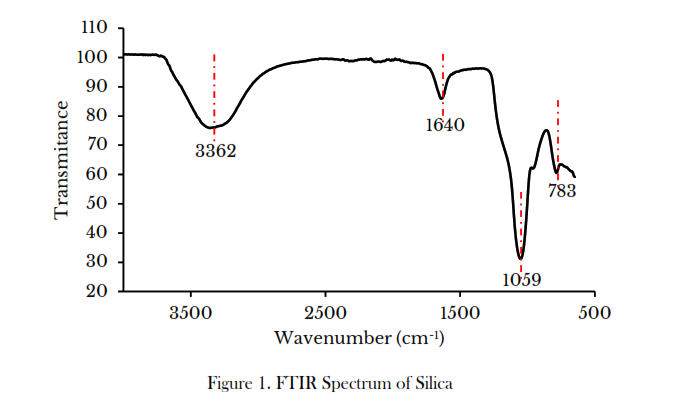
Methylene blue is a persistent dye that can impair light penetration and aquatic photosynthesis, while its chemical stability complicates conventional wastewater treatment. This study developed silica from a 3:1 mixture of rice husk and sugarcane bagasse, enabling the simultaneous valorization of two abundant agricultural residues, and evaluated its performance in a fixed-bed column. We subjected the mixed ash to alkaline extraction and acid precipitation, then characterized it by FTIR, XRD, SEM, and EDX. The product contained characteristic silanol and siloxane groups, exhibited an amorphous structure with a broad XRD peak at 2θ = 22.6°, and showed a rough, agglomerated nanoscale morphology that may provide accessible adsorption sites. At an initial methylene blue concentration of 23.846 mg L⁻¹ and a flow rate of 60 mL min⁻¹, the residual concentration decreased to 0.192 mg L⁻¹ after 80 min, corresponding to 99.19% removal. Removal reached 99.52% after 200 min, indicating promising performance under the tested conditions.
Downloads
References
Alhadhrami, A., Mohamed, G. G., Sadek, A. H., Ismail, S. H., Ebnalwaled, A. A., & Almalki, A. S. A. (2022). Behavior of Silica Nanoparticles Synthesized from Rice Husk Ash by the Sol–Gel Method as a Photocatalytic and Antibacterial Agent. Materials, 15(22). https://doi.org/10.3390/ma15228211
Anisara, R., P.K.W., G. A., & Taufiq, A. (2024). Silica Gel From Bagasse Ash for Methylene Blue Adsorption. 14, 142–153. https://doi.org/https://doi.org/10.31938/jsn.v%2014i3.738
Arora, S., Sitanshu, Katoch, G., & Santhosh, A. J. (2025). Efficient biomass valorization using silica-supported imidazolium-based ionic liquid catalysts. Scientific Reports, 15(1), 1–13. https://doi.org/10.1038/s41598-025-17712-9
Habte, G. A., Bullo, T. A., & Ahmed, Y. (2025). Statistical optimization characterizations and eco-friendly synthesis of silica from sugarcane bagasse. Scientific Reports, 15(1), 1–17. https://doi.org/10.1038/s41598-025-89366-6
Hummadi, K. K., Luo, S., & He, S. (2022). Adsorption of methylene blue dye from the aqueous solution via bio-adsorption in the inverse fluidized-bed adsorption column using the torrefied rice husk. Chemosphere, 287(P1), 131907. https://doi.org/10.1016/j.chemosphere.2021.131907
Hussein, E. B., & Rasheed, F. A. (2025). Sustainable removal of methylene blue from wastewater using silica sand coated with Al2O3nanoparticles: a comparative study of batch and fixed bed column reactors. RSC Advances, 15(59), 50829–50843. https://doi.org/10.1039/d5ra07804k
Khan, I., Saeed, K., Zekker, I., Zhang, B., Hendi, A. H., Ahmad, A., Ahmad, S., Zada, N., Ahmad, H., Shah, L. A., Shah, T., & Khan, I. (2022). Review on Methylene Blue: Its Properties, Uses, Toxicity and Photodegradation. Water, 14(2), 1–30. https://doi.org/https://doi.org/10.3390/w14020242
Khushnood, S., Khan, J. R., Hussain, S., Khan, H., Wahab, F., Ng, K. C., & Shahzad, M. W. (2024). Synthesis and characterization of mesoporous caged silica for efficient adsorption of methylene blue from aqueous solution. International Communications in Heat and Mass Transfer, 156. https://doi.org/10.1016/j.icheatmasstransfer.2024.107706
Kumalasari, M. R., Beladona, S. U. M., Gracia, A. N., Sugiyani, T., Wulandari, O. R., Imelya, M., Syaima, H., & Hanif, Q. A. (2024). Rice Husk Ash: A Promising Heavy Metal Adsorbent For Wastewater Treatment. Walisongo Journal of Chemistry, 7(1), 26–36. https://doi.org/10.21580/wjc.v7i1.18852
Lee, Y.-J., Lee, J.-M., Park, J.-W., Wang, J., Wang, M., Seo, D.-C., & Park, J.-H. (2025). Zero waste realization method of rice husk: Silica extraction and methylene blue adsorption. Sustainable Chemistry and Pharmacy, 48, 102211. https://doi.org/10.1016/j.scp.2025.102211
Lestari, D. I., Ekawati, L., Maliki, S., Putri, Z. P., & Maranggi, I. U. (2026). Fixed-Bed Column Performance of NaOH-Activated Hybrid Adsorbent Derived from Jengkol Peels and Coconut Shells for Cu ( II ) Removal. 8(1), 23–33.
Liang, P., Yang, W., Peng, H., & Zhao, S. (2024). Efficient Degradation of Methylene Blue in Industrial Wastewater and High Cycling Stability of Nano ZnO. Molecules, 29(23). https://doi.org/10.3390/molecules29235584
Maranggi, I. U., Maliki, S., Ekawati, L., Lestari, D. I., & Putri, Z. P. (2026). Utilization of Coconut Shell Activated Carbon as an Eco-Friendly Adsorbent for Cu(II) Remediation in a Continuous Column System. Indonesian Journal of Chemical Science and Technology, 9(1), 158–167.
Matharage, H., Jayaweera, M., Bandara, N., Manatunge, J., Jayawardana, D., & Dissanayake, J. (2025). Fixed-bed column studies on the adsorption of bisphenol A from aqueous solutions using chemically activated king coconut biochar. Discover Chemical Engineering, 5(1). https://doi.org/10.1007/s43938-025-00082-z
Ngabirano, A., Yiga, V. A., & Lubwama, M. (2026). Synthesis and characterization of mesoporous bio-silica nanoparticles developed from rice husks for oil spillage remediation. Results in Engineering, 29(January), 109369. https://doi.org/10.1016/j.rineng.2026.109369
Nurdin, N. A., Syarif, T., & Nurjannah, N. (2023). SINTESIS SILIKA GEL DARI LIMBAH SEKAM PADI (Oryza sativa) DENGAN VARIASI KONSENTRASI JENIS ASAM. Journal of Scientech Research and Development, 5(1 SE-Articles). https://doi.org/10.56670/jsrd.v5i1.169
Nurfitria, N., Febriyantiningrum, K., Utomo, W. P., Nugraheni, Z. V., Pangastuti, D. D., Maulida, H., & Ariyanti, F. N. (2019). Pengaruh Konsentrasi Aktivator Kalium Hidroksida (KOH) pada Karbon Aktif dan Waktu Kontak terhadap Daya Adsorpsi Logam Pb dalam Sampel Air Kawasan Mangrove Wonorejo, Surabaya. Akta Kimia Indonesia, 4(1), 75. https://doi.org/10.12962/j25493736.v4i1.5071
Nurmutaaqimah, Siti Jamilatun, & Aster Rahayu. (2025). Effect of NaOH Concentration on Surface Width and Pore Volume of Silica Gel From Beef Shrain as Adsorbent. Sains Natural: Journal of Biology and Chemistry, 15(2), 102–109. https://doi.org/10.31938/jsn.v15i2.814
Sania, R., Meidinariasty, A., & Ramayanti, C. (2026). Ekstraksi Silika Gel dari Ampas Tebu dan Sekam Padi dengan Variasi Konsentrasi NaOH dan Rasio Bahan Baku. XI(1), 16333–16339.
Sarma, J., Rajkhowa, S., & Das, S. (2024). Synthesis of White Silica From “Joha Rice Husk” (A Special Rice Variety of Assam, India), Characterization and Determination of Its Point of Zero Charge (pHPZC). Journal of Chemistry, 2024(1). https://doi.org/10.1155/joch/5542855
Shareef Radha, F. H., Kareem, M. T., & Abdullah, O. G. (2026). Atmosphere-dependent synthesis and crystallization behavior of silica nanoparticles derived from rice husk biomass. RSC Advances, 16(19), 16874–16886. https://doi.org/10.1039/d6ra00367b
Downloads
Published
How to Cite
Issue
Section
License
Copyright (c) 2026 Linda Ekawati, Syariful Maliki, Dwi Indah Lestari, Aulia Chunissya Salsabila, Eci Septiani

This work is licensed under a Creative Commons Attribution-ShareAlike 4.0 International License.
Authors who publish with this journal agree to the following terms:
- Authors retain copyright and grant the journal right of first publication with the work simultaneously licensed under a Creative Commons Attribution-ShareAlike 4.0 International License that allows others to share the work with an acknowledgment of the work's authorship and initial publication in this journal.
- Authors are able to enter into separate, additional contractual arrangements for the non-exclusive distribution of the journal's published version of the work (e.g., post it to an institutional repository or publish it in a book), with an acknowledgment of its initial publication in this journal.
- Authors are permitted and encouraged to post their work online (e.g., in institutional repositories or on their website) prior to and during the submission process, as it can lead to productive exchanges, as well as earlier and greater citation of published work (See The Effect of Open Access).

This work is licensed under a Creative Commons Attribution-ShareAlike 4.0 International License.