Comparative Synthesis of H₂SO₄-Activated Rice Straw and KOH-Activated Rice Husk Carbons: Evidence from Selected Wastewater Studies
DOI:
https://doi.org/10.30736/seaj.v8i2.1442Keywords:
Activated carbon, Adsorption, Comparative analysis, Rice biomass, Wastewater treatmentAbstract
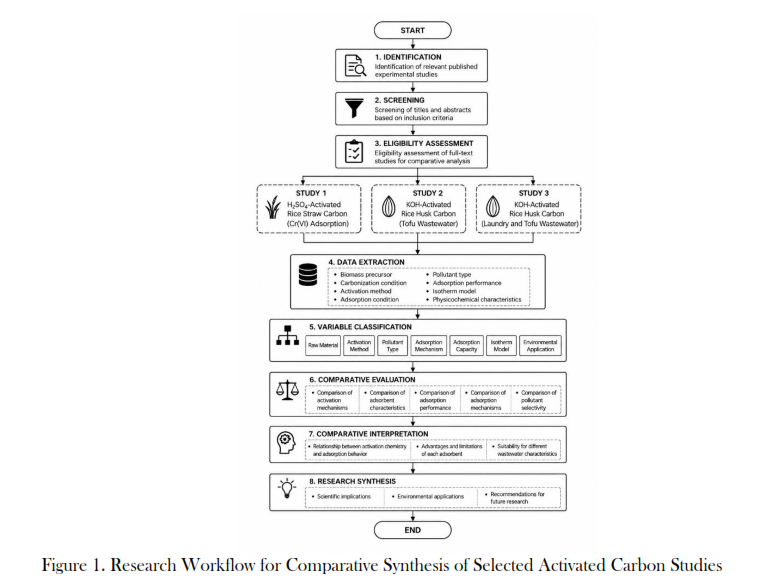
Rice straw and rice husk are promising agricultural residues for producing activated carbon, but reported adsorption performance cannot be compared directly when precursor, activation chemistry, target contaminant, wastewater matrix, and operating conditions differ. This study qualitatively compares three selected experimental studies: H₂SO₄-activated rice straw carbon for Cr(VI) adsorption, KOH-activated rice husk carbon for tofu wastewater, and KOH-activated rice husk carbon for laundry and tofu wastewater. The synthesis compares precursor characteristics, activation conditions, adsorption or treatment conditions, reported performance, isotherm evidence, and potential treatment implications. The H₂SO₄-activated rice straw study reported an adsorption capacity (qₘ) of 5.42 mg/g for Cr(VI) under its reported optimum conditions of pH 7, 100-mesh particle size, and 60 min contact time. The KOH-activated rice husk study for tofu wastewater reported reductions of 27% in Total Dissolved Solids (TDS) and 97% in Total Suspended Solids (TSS), while the comparative laundry/tofu study reported reductions of 82% COD, 27% TDS, and 97% TSS in laundry wastewater and 92% COD, 51% TDS, and 90% TSS in tofu wastewater. These findings are reported within their respective experimental contexts and are not treated as directly comparable performance scores. The synthesis indicates that adsorption behavior is associated with the combined effects of precursor, activation chemistry, pollutant or wastewater characteristics, and operating conditions. The study therefore provides a preliminary comparative framework and identifies the need for standardized experiments to evaluate precursor and activation effects independently.
Downloads
References
Ahmed Alsharif, M. (2025). Understanding Adsorption: Theories, Techniques, and Applications. In Adsorption - Fundamental Mechanisms and Applications. IntechOpen. https://doi.org/10.5772/intechopen.1008865
Akhtar, M., Sarfraz, M., Ahmad, M., Raza, N., & Zhang, L. (2025). Use of low-cost adsorbent for waste water treatment: Recent progress, new trend and future perspectives. In Desalination and Water Treatment (Vol. 321). Elsevier B.V. https://doi.org/10.1016/j.dwt.2024.100914
Alam, M. M., Hossain, M. A., Hossain, M. D., Johir, M. A. H., Hossen, J., Rahman, M. S., Zhou, J. L., Hasan, A. T. M. K., Karmakar, A. K., & Ahmed, M. B. (2020). The potentiality of rice husk-derived activated carbon: From synthesis to application. In Processes (Vol. 8, Number 2). MDPI AG. https://doi.org/10.3390/pr8020203
Bandani, M., Najafi, M., Khalili, S., Jahanshahi, M., Peyravi, M., & Salmani, H. (2026). Preparation and characterization of low-cost chemically activated carbons using H3PO4, ZnCl2 and KOH for CO2 adsorption applications. Scientific Reports, 16(1). https://doi.org/10.1038/s41598-026-35319-6
Downloads
Published
How to Cite
Issue
Section
License
Copyright (c) 2026 Daning Kinanti Sutama, Maylina Ilhami Khurniyati, Shaddiqah Munawaroh Fauziah, Yunita Khilyatun Nisak, Erina Endah Kusuma Wardani

This work is licensed under a Creative Commons Attribution-ShareAlike 4.0 International License.
Authors who publish with this journal agree to the following terms:
- Authors retain copyright and grant the journal right of first publication with the work simultaneously licensed under a Creative Commons Attribution-ShareAlike 4.0 International License that allows others to share the work with an acknowledgment of the work's authorship and initial publication in this journal.
- Authors are able to enter into separate, additional contractual arrangements for the non-exclusive distribution of the journal's published version of the work (e.g., post it to an institutional repository or publish it in a book), with an acknowledgment of its initial publication in this journal.
- Authors are permitted and encouraged to post their work online (e.g., in institutional repositories or on their website) prior to and during the submission process, as it can lead to productive exchanges, as well as earlier and greater citation of published work (See The Effect of Open Access).

This work is licensed under a Creative Commons Attribution-ShareAlike 4.0 International License.