Critical Thinking Skills in High School Biology: Examining the Impact of the Mind Mapping-Assisted RICOSRE Model in an Intact Class Setting
DOI:
https://doi.org/10.30736/seaj.v8i2.1480Keywords:
Critical Thinking, Mind Mapping, RICOSRE Learning ModelAbstract
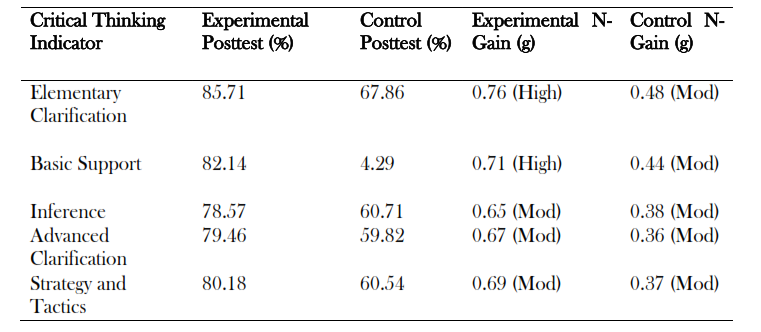
This study aimed to examine the effect of the Reading, Identifying, Constructing, Solving, Reviewing, and Extending (RICOSRE) learning model assisted by Mind Mapping on the critical thinking skills of Grade 10 Biology students. A quantitative quasi-experimental design featuring a non-equivalent pretest-posttest control group design with intact classes was implemented. The study population comprised 112 Grade 10 Science students across four classes at SMAN Bhakti Mulya Bunga Mayang during the 2026/2027 academic year. Using cluster random sampling, two intact classes were selected: Class X.3 (n = 28) served as the experimental group (taught via Mind Mapping-assisted RICOSRE), while Class X.2 (n = 28) served as the control group (taught via conventional Discovery Learning). Data were collected using a validated 10-item essay test measuring five critical thinking indicators adapted from Ennis. Analysis of normalized gain (N-Gain) scores revealed that the experimental group achieved a mean posttest score of 81.21 ± 8.42 with a high average N-Gain of 0.70, whereas the control group obtained a mean posttest score of 62.64 ± 9.15 with a moderate N-Gain of 0.43. Because the posttest data violated normality and homogeneity assumptions, hypothesis testing was performed using the non-parametric Mann-Whitney U test on posttest scores. The test yielded U = 0.50, z = -6.45, p < .001, indicating a statistically significant difference between the two groups. These findings suggest that integrating Mind Mapping specifically during the Constructing syntax of RICOSRE offers a structured visual scaffolding that facilitates students' analytical and evaluative skills in ecosystem topics.
Downloads
References
Arafah, AN, Syaf, AH, & Rizqiyani, R. (2025). The RICOSRE learning model to improve mathematical problem-solving skills. Jurnal Analisa, 11 (2), 156–168. https://doi.org/10.15575/ja.v11i2.51951
Astuti, DD, Mustoip, S., & Aljulia, N. (2024). The role of mind mapping media in revealing primary school students' critical thinking abilities. EduBase: Journal of Basic Education, 5 (2). https://doi.org/10.47453/edubase.v5i2.2845
Badriah, L., Mahanal, S., Zubaidah, S., & Setiawan, D. (2024). Collaborative mind mapping in RICOSRE learning model to improve students' information literacy. International Journal of Evaluation and Research in Education, 13 (1).
DOI: https://doi.org/10.11591/ijere.v13i1.26840
Fauziah, ANM, Wasis, Hendratmoko, AF, Mahdiannur, MA, Ermawan, MZF, Suwandi, E., & Ratri, SY (2024). Relationship between critical thinking and scientific argumentation in science learning. Indonesian Journal of Science Education. https://doi.org/10.15294/pwqxcp96
Fraenkel, J.R., Wallen, N.E., & Hyun, H.H. (2019). How to design and evaluate education research (10th ed.). McGraw-Hill Education.
Irdalisa, I., Akbar, B., Fuadi, T.M., Maesaroh, M., & Kartikawati, E. (2024). RICOSRE model with Question Formulation Technique (QFT): Enhancing students' higher-order thinking skills (HOTS) and science literacy. Journal of Science Education Research, 10 (3), 1175–1178. https://doi.org/10.29303/jppipa.v10i3.6764
Lianto, L., & Rohayati, YT. (2025). Promoting students' critical thinking and cognitive learning outcomes through problem-based learning integrated with mind-mapping. Journal of Incandescent Mathematics and Natural Sciences, 20 (7), 1232–1238. https://doi.org/10.29303/jpm.v20i7.10243
Mahanal, S., Zubaidah, S., Setiawan, D., & Maghfiroh, H. (2025). Synergy of RICOSRE with Flipped Classroom: An innovative approach to enhancing students' scientific thinking skills. TEM Journal .
DOI: https://doi.org/10.18421/TEM142-54
Mufliha, N., Maulana, A., Hamansah, & Taufiq, AU (2025). The effect of the Reading, Identifying, Constructing, Solving, Reviewing, and Extending (RICOSRE) learning model on students' critical thinking skills. Diklabio: Journal of Biology Education and Learning, 9 (2), 227–235. https://doi.org/10.33369/diklabio.9.2.227-235
Naharuddin, MA, Ismail, I., Faisal, F., Azis, AA, & Daud, F. (2026). The effect of implementing the RICOSRE learning model on critical thinking skills, problem-solving skills, and student learning outcomes on coordination system material. JIIP: Scientific Journal of Educational Sciences, 9 (2). https://doi.org/10.54371/jiip.v9i2.10513
Nuraini, N., & Antika, R.N. (2024). Exploring biology students' critical thinking using mind maps. Journal of Science Education Research, 10 (7), 4112–4117. https://doi.org/10.29303/jppipa.v10i7.7115
Nurmalia, SA, Meliani, A., & Rachman, IF (2025). The Role of the Independent Curriculum in Encouraging Critical Thinking through Contextual Learning. Indonesian Journal of Educational Research, 2 (4), 233–242. https://doi.org/10.62017/jppi.v2i4.4486
Orhan, A. (2023). Fake news detection on social media: The predictive role of university students' critical thinking dispositions and new media literacy. Smart Learning Environments, 10 (1), 29. https://doi.org/10.1186/s40561-023-00248-8
Sari, NMD, Suastra, IW, Arnyana, IBP, & Wibawa, IMC (2025). The role of science education in developing 21st-century competencies, specifically critical thinking skills. Indonesian Journal of Instruction, 6 (3), 646–660. https://doi.org/10.23887/iji.v6i3.106038
Sugiyono. (2019). Quantitative, qualitative, and R&D research methods. Alfabeta.
Sumah, V., Rumahlatu, D., & Liline, S. (2024). The influence of the RICOSRE-PBL (Problem-Based Learning) model on cognitive learning outcomes, creative thinking, and critical thinking in ecology and biodiversity materials. Bioedupat: Pattimura Journal of Biology and Learning, 4 (2), 230–240. https://doi.org/10.30598/bioedupat.v4.i2.pp230-240
Supriatna, MYS, Mustofa, RF, & Diella, D. (2025). RICOSRE and Miro: Teaching approach for improving scientific argumentation skills in ecosystem materials. Asian Journal of Education and Social Studies, 51 (7), 788–799. https://doi.org/10.9734/ajess/2025/v51i72169
Winda, FHA, & Suyanto, S. (2025). The effect of the RICOSRE learning model on students' problem-solving abilities in virus material. Journal of Biology Education, 11 (1), 99–107. https://doi.org/10.21831/edubio.v11i1.20612
Faridah, F., Luthfiyati, D., Fatmawaty, R., Asrori, M., Sukardi, S., Septaria, K., & Zamroni, M. R. (2026). Peningkatan Kapasitas Publikasi Ilmiah Guru MIUS Lamongan melalui Pelatihan Pemetaan Bibliometrik dan Pendekatan Futures Thinking. Bhakti Nusantara: Jurnal Pengabdian Kepada Masyarakat, 2(1), 25-43.
Huda, M., Septaria, K., Rosdiana, S. R., Shafikha, R., & Salami, W. (2026). DEVELOPING AUGMENTED REALITY-BASED LEARNING MEDIA FOR TSUNAMI MITIGATION TO ADDRESS STUDENT MICRO-LEARNING CHALLENGES. JPPIPA (Jurnal Penelitian Pendidikan IPA), 11(1), 33-47.
Fatharani, A., Madlazim, M., Anggaryani, M., Satriawan, M., & Septaria, K. (2026). Learning from Earthquakes: The Role of Socio-Scientific Issues in Developing Students’ Science Argumentation Skills. Prisma Sains: Jurnal Pengkajian Ilmu dan Pembelajaran Matematika dan IPA IKIP Mataram, 14(1), 123-143.
Hendratmoko, A. F., Fauziah, A. N. M., Susiyawati, E., Astriani, D., Nurita, T., Martini, M., ... & Boey, A. (2026). Integrating ChatGPT-driven self-assessment and Debate Based on Inquiry Learning (DBOIL) to enhance students’ argumentation skills: Leveraging AI for quality science learning aligned with SDG 4. In E3S Web of Conferences (Vol. 696, p. 02005). EDP Sciences.
Septaria, K., Asrori, M., Setyo, C. Y., Faridah, F., Anam, M. K., Sukardi, S., & Kholiq, A. (2025). Pemberdayaan Guru Ma'arif melalui Pemanfaatan Deep Learning Engagement Tools untuk Peningkatan Literasi Digital dan Pedagogis. Bhakti Nusantara: Jurnal Pengabdian Kepada Masyarakat, 1(1), 25-39.
Septaria, K., Fatharani, A., & Baihaqi, A. (2025). Are Scrapbooks Able to Increase Tsunami Disaster Literacy? An Analytical Study of Junior High School Students Materials. SEJ (Science Education Journal), 9(2), 115-133. https://doi.org/10.21070/sej.v9i2.1656
Septaria, K., Fatharani, A., Supardi, Z. A. I., Suyono, S., & Regita, M. A. (2025). Pengembangan Sikap Ilmiah Abad 21 Melalui Lembar Kerja Berbasis Teori Pembelajaran Sosial pada Materi Listrik Statis. Jurnal Penelitian Sains dan Pendidikan (JPSP), 5(1), 65-86. https://doi.org/10.23971/jpsp.v5i1.9758
Sho'idah, Y., Septaria, K., & Wulandari, S. A. (2025). Analysis of Student Scientific Communication Based on The Development and Use of Diorama Media Using The Guided Inquiry Model. Reforma: Jurnal Pendidikan dan Pembelajaran, 15(1), 24-47. https://doi.org/10.30736/reforma.v15i1.1207
Hendratmoko, A. F., Puspitarini, S., Budiyanto, M., Rahman, N., Septaria, K., & Marpuah, S. (2025). Think-Aloud Protocol as a Method for Exploring and Understanding the Argumentation Skills of Pre-Service Science Teachers. Prisma Sains: Jurnal Pengkajian Ilmu dan Pembelajaran Matematika dan IPA IKIP Mataram, 13(2), 268-282. https://doi.org/10.33394/j-ps.v13i2.15214
Septaria, K., Fatharani, A., Dewanti, B. A., & Najawa, W. C. (2024). Designing Pirposal-learning based Module integrated with Socio-Scientific Issue to Enhance Students’ Scientific Reasoning Skill. Indonesian Journal of Mathematics and Natural Science Education, 5(2), 122-134. https://doi.org/10.35719/mass.v5i2.162
Septaria, K., Nissak, K., & Wulandari, S. A. (2023). Student Identity and Guided Inquiry Learning in Junior High School Students: A Correlation Analysis. Jurnal Penelitian Pendidikan IPA, 9(10), 8351-8358. https://doi.org/10.29303/jppipa.v9i10.4584
Septaria, K., Dewanti, B. A., & El Afidah, M. I. (2020). Development of module disaster mitigation based on STEM for secondary schools. JPPIPA (Jurnal Penelitian Pendidikan IPA), 5(2), 61-68. https://doi.org/10.26740/jppipa.v5n2.p61-68
Septaria, K. (2019). Mengeksplorasi Argumentasi dan Pengetahuan Pendidik Ilmu Pengetahuan Alam (IPA) tentang Pemanasan Global. PEDAGOGIA: Jurnal Pendidikan, 8(2), 247-256. https://doi.org/10.21070/pedagogia.v8i2.2369
Septaria, K., & Fatharani, A. (2022). Analisis Penggunaan Software PlantNet Terhadap Pemerolehan Konsep Dan Keterampilan Prosedural Siswa. Indonesian Journal of Educational Science (IJES), 5(1), 73-83. https://doi.org/10.31605/ijes.v5i1.1604
Septaria, K., Dewanti, B. A., & Habibbulloh, M. (2019). Implementasi metode pembelajaran spot capturing pada materi pemanasan global untuk meningkatkan keterampilan proses sains. Prisma Sains: Jurnal Pengkajian Ilmu dan Pembelajaran Matematika dan IPA IKIP Mataram, 7(1), 27-37. https://doi.org/10.33394/j-ps.v0i0.1379
Septaria, K., & Fatharani, A. (2022). Manga versus webtoon: Alternative science learning module based on Dr Stone. Jurnal Inovasi Pendidikan IPA, 8(1), 11-22. https://doi.org/10.21831/jipi.v8i1.43389
Septaria, K., & Haque, E. H. (2022). Upaya Peningkatan Pengetahuan Masyarakat terhadap Covid-19 Menggunakan Media Poster. TAAWUN, 2(02), 115-124.
Septaria, K., Sholihin, M., Kholiq, A., Hayati, E., & Maulana, V. I. P. (2022). Peningkatan Kualitas Pendidik dan Pembelajaran Menuju Madrasah yang Ungggul dan Berkelanjutan. Jurnal Berdaya Mandiri, 4(2), 167-181. https://doi.org/10.31316/jbm.v4i2.1742
Downloads
Published
How to Cite
Issue
Section
License
Copyright (c) 2026 Laila Puspita, Ahirul Umah, Aryani Dwi Kesumawardani

This work is licensed under a Creative Commons Attribution-ShareAlike 4.0 International License.
Authors who publish with this journal agree to the following terms:
- Authors retain copyright and grant the journal right of first publication with the work simultaneously licensed under a Creative Commons Attribution-ShareAlike 4.0 International License that allows others to share the work with an acknowledgment of the work's authorship and initial publication in this journal.
- Authors are able to enter into separate, additional contractual arrangements for the non-exclusive distribution of the journal's published version of the work (e.g., post it to an institutional repository or publish it in a book), with an acknowledgment of its initial publication in this journal.
- Authors are permitted and encouraged to post their work online (e.g., in institutional repositories or on their website) prior to and during the submission process, as it can lead to productive exchanges, as well as earlier and greater citation of published work (See The Effect of Open Access).

This work is licensed under a Creative Commons Attribution-ShareAlike 4.0 International License.