Metacognitive Scaffolding through AI-Assisted Digital Annotation: Developing Argument Evaluation and Inference-Making in EFL Academic Reading
DOI:
https://doi.org/10.30736/reforma.v16i1.1369Keywords:
AI-assisted learning, Critical reading, Classroom Action Research, Metacognitive awarenessAbstract
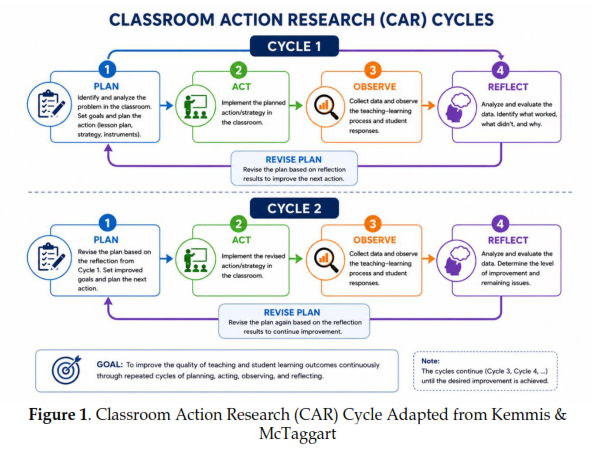
The integration of generative AI into academic reading contexts presents both a transformative scaffolding opportunity and a pedagogical risk: without deliberate instructional design, students may default to passive, query-and-paste AI use that reinforces surface-level text processing rather than analytical engagement. This Classroom Action Research (CAR) study investigated the effectiveness of AI-assisted digital annotation as a pedagogical intervention for improving undergraduate EFL students’ critical reading of academic texts. Guided by the Kemmis and McTaggart spiral model, the study was implemented across two iterative cycles with a class of 50 undergraduate students enrolled in Bahasa Inggris course at an Indonesian higher education institution. Data were collected through Critical Reading Performance Tests (pre-test and post-test per cycle) and classroom observation, and were analysed using a mixed-method approach integrating paired-samples t-tests with thematic analysis following Miles, Huberman, and Saldaña’s interactive model. Findings demonstrated statistically significant improvements in critical reading performance across both cycles, with a cumulative mean gain of 28.8 points from pre-test (M = 49.8) to the Cycle II post-test (M = 78.6; p < .001, Cohen’s d = 1.59), and 83.3% of students surpassing the predetermined success threshold. Qualitative findings documented a shift from passive paraphrastic annotation to interrogative critical dialogue with both text and AI tool. The study concluded that AI-assisted digital annotation, when embedded within a structured pedagogical framework and accompanied by explicit instruction in critical AI interrogation, constituted an effective and ecologically valid strategy for developing students’ critical reading competencies in EFL higher education contexts.
Downloads
References
Abbas, Z., Hussain, A., Abbas, S. Z., Ahmad, N., Fatima, N., & Khan, F. (2025). Integrating Artificial Intelligence into Reading Comprehension Instruction: Opportunities and Pedagogical Strategies. Research Journal for Social Affairs, 3(6), 97–109. https://doi.org/10.71317/RJSA.003.06.0432
Ajideh, P., Zohrabi, M., & Pouralvar, K. (2018). The Effect of Explicit Instruction of Metacognitive Reading Strategies on ESP Reading Comprehension in Academic Settings. International Journal of Applied Linguistics & English Literature, 7(4), 77–86. https://doi.org/10.7575/aiac.ijalel.v.7n.4p.77
Al-shaye, S. (2021). Cypriot Journal of Educational skills , and self-regulated learning skills. Cypriot Journal of Educational Sciences, 16(4), 2049–2069. https://doi.org/10.18844/cjes.v16i4.6074
Allen, J. P., Hafen, C. A., Gregory, A. C., Mikami, A. Y., & Pianta, R. (2015). Enhancing Secondary School Instruction and Student Achievement: Replication and Extension of the My Teaching Partner-Secondary Intervention. Journal of Research on Educational Effectiveness, 8(4), 475–489. https://doi.org/10.1080/19345747.2015.1017680
Altwijri, L., & Abdelhalim, S. M. (2026). Enhancing reading engagement in adult EFL classrooms through AI-supported instruction : A mixed-methods study. System, 136, 103906. https://doi.org/10.1016/j.system.2025.103906
Anggraini, G. F., Sunendar, D., Damaianti, V. S., & Musthafa, B. (2026). Enhancing Students’ Critical Reading Skills through the Integration of Critical Literacy Pedagogy and Teacher-Parent Collaboration Program. Indonesian Journal on Learning and Advanced Education (IJOLAE), 8(1), 116–130. https://doi.org/10.23917/ijolae.v8i1.13366
Babashamasi, P., Noordin, N. B., & Kotamjani, S. S. (2022). The Effect of Teaching Metacognitive Reading Strategies on the Critical Thinking Skills of Undergraduate Students. International Journal of Applied Linguistics & English Literature, 11(2), 65–71. https://doi.org/10.7575/aiac.ijalel.v.11n.2p.65
Benitez, C., Quinones, A., Gonzalez, P., Ochoa, C., & Alba Vargas. (2020). THE IMPACT OF ONLINE ANNOTATION TOOLS ON STUDENTS ’ ACADEMIC PERFORMANCE IN A DISTANCE UNIVERSITY. Turkish Online Journal of Distance Education (TOJDE), 21(2), 167–177.
Bjorn, G. (2023). The Power of Peer Engagement : Exploring the Effects of Social Comprehension of Primary Literature. AI, Computer Science and Robotics Technology, 2(1), 1–32. https://doi.org/10.5772/acrt.24
Bjorn, G. (2024). The CERIC method plus social collaborative annotation improves critical reading of the primary literature in an interdisciplinary graduate course. Frontiers in Education, 9, 1257747. https://doi.org/10.3389/feduc.2024.1257747
Chand, S. P. (2025). Methods of Data Collection in Qualitative Research: Interviews, Focus Groups, Observations, and Document Analysis. Advances in Educational Research and Evaluation, 6(1), 303–317. https://doi.org/10.25082/AERE.2025.01.001
Chang, L., Wang, Y., Liu, J., Zhang, X., & Feng, Y. (2023). Study on factors influencing college students ’ digital academic reading behavior. Frontiers in Psychology, January, 1–13. https://doi.org/10.3389/fpsyg.2022.1007247
Fan, K. (2025). Enhancing Cognitive Reading Strategy Use for L2 Learners with Lower Working Memory through AI-Based Scaffolding. Journal of English Language Teaching and Applied Linguistics, 7(3), 143–151. https://doi.org/10.32996/jeltal
Downloads
Published
How to Cite
Issue
Section
License
Copyright (c) 2026 Yanti Anggraini

This work is licensed under a Creative Commons Attribution-ShareAlike 4.0 International License.
Penulis yang mempublikasikan naskahnya pada Jurnal ini menyetujui ketentuan berikut:
- Hak cipta pada setiap artikel adalah milik penulis, dan penulis mengakui bahwa Reforma : Jurnal Pendidikan dan Pembelajaran berhak sebagai pihak yang mempublikasikan pertama kali dengan lisensi Attribution-ShareAlike 4.0 International (CC BY-SA 4.0).
- Lisensi ini mengizinkan setiap orang untuk:
- Berbagi — menyalin dan menyebarluaskan kembali materi ini dalam bentuk atau format apapun;
- Adaptasi — menggubah, mengubah, dan membuat turunan dari materi ini untuk kepentingan apapun, termasuk kepentingan komersial.
Berdasarkan ketentuan berikut:
- Atribusi —Mereka harus mencantumkan nama yang sesuai, mencantumkan tautan terhadap lisensi, dan menyatakan bahwa telah ada perubahan yang dilakukan. Mereka dapat melakukan hal ini dengan cara yang sesuai, namun tidak mengisyaratkan bahwa pemberi lisensi mendukung Mereka atau penggunaan Mereka.
- BerbagiSerupa — Apabila Mereka menggubah, mengubah, atau membuat turunan dari materi ini, Mereka harus menyebarluaskan kontribusi Mereka di bawah lisensi yang sama dengan materi asli.
- Tidak ada pembatasan tambahan — Mereka tidak dapat menggunakan ketentuan hukum atau sarana kontrol teknologi yang secara hukum membatasi orang lain untuk melakukan hal-hal yang diizinkan lisensi ini.
- Penulis dapat memasukan tulisan secara terpisah, mengatur distribusi non-ekskulif  dari naskah yang telah terbit di jurnal ini kedalam versi yang lain (misal: dikirim ke respository institusi penulis, publikasi kedalam buku, dll), dengan mengakui bahwa naskah telah terbit pertama kali pada Reforma : Jurnal Pendidikan dan Pembelajaran