From Tool to Cognitive Partner: Reconfiguring History Teaching through Transhumanist AI
DOI:
https://doi.org/10.30736/reforma.v16i2.1456Keywords:
Artificial Intelligence, History Education, Historical Thinking, Transhumanism, Human AgencyAbstract
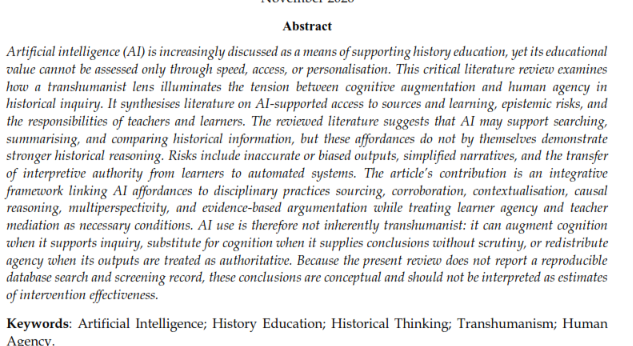
Artificial intelligence (AI) is increasingly discussed as a means of supporting history education, yet its educational value cannot be assessed only through speed, access, or personalisation. This critical literature review examines how a transhumanist lens illuminates the tension between cognitive augmentation and human agency in historical inquiry. It synthesises literature on AI-supported access to sources and learning, epistemic risks, and the responsibilities of teachers and learners. The reviewed literature suggests that AI may support searching, summarising, and comparing historical information, but these affordances do not by themselves demonstrate stronger historical reasoning. Risks include inaccurate or biased outputs, simplified narratives, and the transfer of interpretive authority from learners to automated systems. The article’s contribution is an integrative framework linking AI affordances to disciplinary practices sourcing, corroboration, contextualisation, causal reasoning, multiperspectivity, and evidence-based argumentation while treating learner agency and teacher mediation as necessary conditions. AI use is therefore not inherently transhumanist: it can augment cognition when it supports inquiry, substitute for cognition when it supplies conclusions without scrutiny, or redistribute agency when its outputs are treated as authoritative. Because the present review does not report a reproducible database search and screening record, these conclusions are conceptual and should not be interpreted as estimates of intervention effectiveness.
Downloads
References
Almada, Y. A., Puspita, D., & Susilo, A. (2024). Penerapan teknologi dan media pembelajaran sejarah berbasis virtual reality dalam peningkatan pemahaman konseptual siswa. Danadyaksa Historica, 4(2), 67–72. https://doi.org/10.32502/jdh.v4i2.8987
Anggoro, D. (2025). Integrating digital archives and artificial intelligence: A conceptual model for inquiry-based local history education. Indonesian Journal of History Education, 10(2), 1–18. https://doi.org/10.15294/ijhe.v10.i2.22576
Bergsma, A. (2000). Transhumanism and the wisdom of old genes: Is neurotechnology a source of future happiness? Journal of Happiness Studies, 1(3), 401–417. https://doi.org/10.1023/A:1010016532529
Bila, S., & Lozynska, I. (2025). Negative consequences of using artificial intelligence in studying history at school. Scientific Journal Virtus, 74–78. https://doi.org/10.24919/2308-4634.2025.349409
Chan, C. K. Y., & Hu, W. (2023). Students' voices on generative AI: Perceptions, benefits, and challenges in higher education. International Journal of Educational Technology in Higher Education, 20, Article 43. https://doi.org/10.1186/s41239-023-00411-8
Choi, B.-T. (2025). Identifying issues and seeking improvements in history education through the use of generative AI. The Journal of Educational Development, 45(1), 283–300. https://doi.org/10.34245/jed.45.1.283
Copeland, B. J. (2026, October 9). Artificial intelligence. In Encyclopaedia Britannica. https://www.britannica.com/technology/artificial-intelligence
Farah, M. J., Smith, M. E., Ilieva, I., & Hamilton, R. H. (2014). Cognitive enhancement. WIREs Cognitive Science, 5(1), 95–103. https://doi.org/10.1002/wcs.1269
Fatimah, N., & Octaviani, D. (2023). Sejarah pendidikan Indonesia baru: Perkembangan pembelajaran sejarah berbasis artificial intelligence (AI) 4.0. Jurnal Sejarah Indonesia, 6(2), 168–179. https://doi.org/10.62924/jsi.v6i2.32607
Jamaaluddin, & Sulistyowati, I. (2021). Buku ajar mata kuliah kecerdasan buatan (artificial intelligence). Umsida Press. https://doi.org/10.21070/2021/978-623-6292-25-9
Kementerian Pendidikan Dasar dan Menengah. (2025). Panduan pemanfaatan kecerdasan artifisial untuk guru pendidikan anak usia dini, pendidikan dasar, dan pendidikan menengah.
Klichowski, M. (2015). The educational and social world of a child: Discourses of communication, subjectivity and cyborgization. Wydawnictwo Naukowe UAM.
Miskawi, K. A., Arrasuly, M. Y., & Purwanta, H. (2025). Pengembangan keterampilan berpikir historis melalui pembelajaran sejarah. Sindang: Jurnal Pendidikan Sejarah dan Kajian Sejarah, 7(1), 13–20. https://doi.org/10.31540/sindang.v7i1.3201
Nabila, N. A., & Rachman, I. F. (2025). Peran AI dalam mendeteksi dan mengintervensi keterlambatan belajar siswa di pendidikan dasar. Jurnal Kesehatan dan Kebidanan Nusantara, 3(2), 36–43. https://doi.org/10.69688/jkn.v3i2.176
Nasution, J. S., Siregar, A. M., Hasibuan, E. S., Difla, F., & Azizah, T. N. (2025). Dampak negatif penggunaan AI terhadap mahasiswa dalam proses pembelajaran. AMI: Jurnal Pendidikan dan Riset, 3(1), 35–42. https://jurnaltarbiyah.uinsu.ac.id/index.php/ami/article/view/4293/1714
Nasution, R. A., Yuyung, R., Putri, N., & Fauzi, R. (2025). Transhumanisme dalam perspektif teologi Islam: Rekonstruksi konsep kemanusiaan di era digital. Kamali: Jurnal Ilmu Agama, 1(1), 65–79. https://doi.org/10.64691/kamali.v1i1.81
Nyholm, S. (2024). Artificial intelligence and human enhancement: Can AI technologies make us more (artificially) intelligent? Cambridge Quarterly of Healthcare Ethics, 33(1), 76–88. https://doi.org/10.1017/S0963180123000464
Ouida, H., Marfouk, M., El Gourari, W., & Ed-Dali, R. (2025). History education and generative AI: Navigating accuracy and bias. Études de Langue et Littérature, 3, 119–137. https://doi.org/10.34874/PRSM/languelitterature-n3.4213
Pradita, S. M., Saripudin, D., Yulifar, L., & Wiyanarti, E. (2025). Menilik efek disruptif penggunaan teknologi artificial intelligence dalam pembelajaran sejarah. Jurnal Humanitas: Katalisator Perubahan dan Inovator Pendidikan, 11(4), 1012–1025. https://doi.org/10.29408/jhm.v11i4.32748
Rifky, S. (2024). Dampak penggunaan artificial intelligence bagi pendidikan tinggi. Indonesian Journal of Multidisciplinary on Social and Technology, 2(1), 37–42. https://doi.org/10.31004/ijmst.v2i1.287
Serrano-Ausejo, E. (2025). Exploring teachers' views on using immersive virtual reality for teaching history. Digital Education Review, 47, 108–126. https://doi.org/10.1344/der.2025.47.108-126
Shatzer, J. (2019). Transhumanism and the image of God: Today's technology and the future of Christian discipleship. IVP Academic.
Susilo, A., Anwar, K., & Djono. (2024). Transformasi paradigma pembelajaran sejarah pada peserta didik di era revolusi industri 4.0. Kaganga: Jurnal Pendidikan Sejarah dan Riset Sosial Humaniora, 7(2). https://doi.org/10.31539/kaganga.v7i2.12559
Septaria, K., Nadhiroh, S., Setyaningsih, S., Dewanti, B. A., Asy'ad, W. A., & Sa'diyyah, L. (2026). Penerapan Model Predict-Observe-Explain untuk Mengembangkan Keterampilan Pemecahan Masalah Pada Materi Klasifikasi Materi. Edukimbiosis: Jurnal Pendidikan IPA, 5(1), 28-49.
Faridah, F., Luthfiyati, D., Fatmawaty, R., Asrori, M., Sukardi, S., Septaria, K., & Zamroni, M. R. (2026). Peningkatan Kapasitas Publikasi Ilmiah Guru MIUS Lamongan melalui Pelatihan Pemetaan Bibliometrik dan Pendekatan Futures Thinking. Bhakti Nusantara: Jurnal Pengabdian Kepada Masyarakat, 2(1), 25-43.
Huda, M., Septaria, K., Rosdiana, S. R., Shafikha, R., & Salami, W. (2026). DEVELOPING AUGMENTED REALITY-BASED LEARNING MEDIA FOR TSUNAMI MITIGATION TO ADDRESS STUDENT MICRO-LEARNING CHALLENGES. JPPIPA (Jurnal Penelitian Pendidikan IPA), 11(1), 33-47.
Fatharani, A., Madlazim, M., Anggaryani, M., Satriawan, M., & Septaria, K. (2026). Learning from Earthquakes: The Role of Socio-Scientific Issues in Developing Students’ Science Argumentation Skills. Prisma Sains: Jurnal Pengkajian Ilmu dan Pembelajaran Matematika dan IPA IKIP Mataram, 14(1), 123-143.
Septaria, K., Asrori, M., Setyo, C. Y., Faridah, F., Anam, M. K., Sukardi, S., & Kholiq, A. (2025). Pemberdayaan Guru Ma'arif melalui Pemanfaatan Deep Learning Engagement Tools untuk Peningkatan Literasi Digital dan Pedagogis. Bhakti Nusantara: Jurnal Pengabdian Kepada Masyarakat, 1(1), 25-39.
Khasanah, S. N., Septaria, K., & Rosdiana, S. R. (2025). Developmet Of WE-ARe Based Teaching Modules on Flood Disaster Mitigation Material to Train Students' Scientific Literacy. Indonesian Journal of Mathematics and Natural Science Education, 6(2), 142-158.
Septaria, K., Fatharani, A., & Baihaqi, A. (2025). Are Scrapbooks Able to Increase Tsunami Disaster Literacy? An Analytical Study of Junior High School Students Materials. SEJ (Science Education Journal), 9(2), 115-133. https://doi.org/10.21070/sej.v9i2.1656
Septaria, K., Fatharani, A., Supardi, Z. A. I., Suyono, S., & Regita, M. A. (2025). Pengembangan Sikap Ilmiah Abad 21 Melalui Lembar Kerja Berbasis Teori Pembelajaran Sosial pada Materi Listrik Statis. Jurnal Penelitian Sains dan Pendidikan (JPSP), 5(1), 65-86. https://doi.org/10.23971/jpsp.v5i1.9758
Sho'idah, Y., Septaria, K., & Wulandari, S. A. (2025). Analysis of Student Scientific Communication Based on The Development and Use of Diorama Media Using The Guided Inquiry Model. Reforma: Jurnal Pendidikan dan Pembelajaran, 15(1), 24-47. https://doi.org/10.30736/reforma.v15i1.1207
Hendratmoko, A. F., Puspitarini, S., Budiyanto, M., Rahman, N., Septaria, K., & Marpuah, S. (2025). Think-Aloud Protocol as a Method for Exploring and Understanding the Argumentation Skills of Pre-Service Science Teachers. Prisma Sains: Jurnal Pengkajian Ilmu dan Pembelajaran Matematika dan IPA IKIP Mataram, 13(2), 268-282. https://doi.org/10.33394/j-ps.v13i2.15214
Septaria, K., Fatharani, A., Dewanti, B. A., & Najawa, W. C. (2024). Designing Pirposal-learning based Module integrated with Socio-Scientific Issue to Enhance Students’ Scientific Reasoning Skill. Indonesian Journal of Mathematics and Natural Science Education, 5(2), 122-134. https://doi.org/10.35719/mass.v5i2.162
Septaria, K., Nissak, K., & Wulandari, S. A. (2023). Student Identity and Guided Inquiry Learning in Junior High School Students: A Correlation Analysis. Jurnal Penelitian Pendidikan IPA, 9(10), 8351-8358. https://doi.org/10.29303/jppipa.v9i10.4584
Septaria, K., Dewanti, B. A., & El Afidah, M. I. (2020). Development of module disaster mitigation based on STEM for secondary schools. JPPIPA (Jurnal Penelitian Pendidikan IPA), 5(2), 61-68. https://doi.org/10.26740/jppipa.v5n2.p61-68
Septaria, K. (2019). Mengeksplorasi Argumentasi dan Pengetahuan Pendidik Ilmu Pengetahuan Alam (IPA) tentang Pemanasan Global. PEDAGOGIA: Jurnal Pendidikan, 8(2), 247-256. https://doi.org/10.21070/pedagogia.v8i2.2369
Septaria, K., & Fatharani, A. (2022). Analisis Penggunaan Software PlantNet Terhadap Pemerolehan Konsep Dan Keterampilan Prosedural Siswa. Indonesian Journal of Educational Science (IJES), 5(1), 73-83. https://doi.org/10.31605/ijes.v5i1.1604
Septaria, K., Dewanti, B. A., & Habibbulloh, M. (2019). Implementasi metode pembelajaran spot capturing pada materi pemanasan global untuk meningkatkan keterampilan proses sains. Prisma Sains: Jurnal Pengkajian Ilmu dan Pembelajaran Matematika dan IPA IKIP Mataram, 7(1), 27-37. https://doi.org/10.33394/j-ps.v0i0.1379
Septaria, K., & Fatharani, A. (2022). Manga versus webtoon: Alternative science learning module based on Dr Stone. Jurnal Inovasi Pendidikan IPA, 8(1), 11-22. https://doi.org/10.21831/jipi.v8i1.43389
Septaria, K., & Haque, E. H. (2022). Upaya Peningkatan Pengetahuan Masyarakat terhadap Covid-19 Menggunakan Media Poster. TAAWUN, 2(02), 115-124.
Septaria, K., Sholihin, M., Kholiq, A., Hayati, E., & Maulana, V. I. P. (2022). Peningkatan Kualitas Pendidik dan Pembelajaran Menuju Madrasah yang Ungggul dan Berkelanjutan. Jurnal Berdaya Mandiri, 4(2), 167-181. https://doi.org/10.31316/jbm.v4i2.1742
Zakiyah, N. U., Ameera, V., Ritonga, A. E., Aisah, N., Awwaliyah Lingga, S., & Akmalia, R. (2024). Penggunaan AI dalam dunia pendidikan. MAHIRA: Journal of Arabic Studies, 4(1). https://doi.org/10.55380/mahira.v4i1.797
Downloads
Published
How to Cite
Issue
Section
License
Copyright (c) 2026 Bintang Putra Rachmad, Sariyatun

This work is licensed under a Creative Commons Attribution-ShareAlike 4.0 International License.
Penulis yang mempublikasikan naskahnya pada Jurnal ini menyetujui ketentuan berikut:
- Hak cipta pada setiap artikel adalah milik penulis, dan penulis mengakui bahwa Reforma : Jurnal Pendidikan dan Pembelajaran berhak sebagai pihak yang mempublikasikan pertama kali dengan lisensi Attribution-ShareAlike 4.0 International (CC BY-SA 4.0).
- Lisensi ini mengizinkan setiap orang untuk:
- Berbagi — menyalin dan menyebarluaskan kembali materi ini dalam bentuk atau format apapun;
- Adaptasi — menggubah, mengubah, dan membuat turunan dari materi ini untuk kepentingan apapun, termasuk kepentingan komersial.
Berdasarkan ketentuan berikut:
- Atribusi —Mereka harus mencantumkan nama yang sesuai, mencantumkan tautan terhadap lisensi, dan menyatakan bahwa telah ada perubahan yang dilakukan. Mereka dapat melakukan hal ini dengan cara yang sesuai, namun tidak mengisyaratkan bahwa pemberi lisensi mendukung Mereka atau penggunaan Mereka.
- BerbagiSerupa — Apabila Mereka menggubah, mengubah, atau membuat turunan dari materi ini, Mereka harus menyebarluaskan kontribusi Mereka di bawah lisensi yang sama dengan materi asli.
- Tidak ada pembatasan tambahan — Mereka tidak dapat menggunakan ketentuan hukum atau sarana kontrol teknologi yang secara hukum membatasi orang lain untuk melakukan hal-hal yang diizinkan lisensi ini.
- Penulis dapat memasukan tulisan secara terpisah, mengatur distribusi non-ekskulif  dari naskah yang telah terbit di jurnal ini kedalam versi yang lain (misal: dikirim ke respository institusi penulis, publikasi kedalam buku, dll), dengan mengakui bahwa naskah telah terbit pertama kali pada Reforma : Jurnal Pendidikan dan Pembelajaran