Color Characteristics of Local Plant-Derived Natural Dyes for Hand-Drawn Batik Using Dip and Brush Dyeing Techniques
DOI:
https://doi.org/10.30736/seaj.v8i2.1479Keywords:
fixative, hand-drawn batik, natural dyes, potential of local plants, sustainable textileAbstract
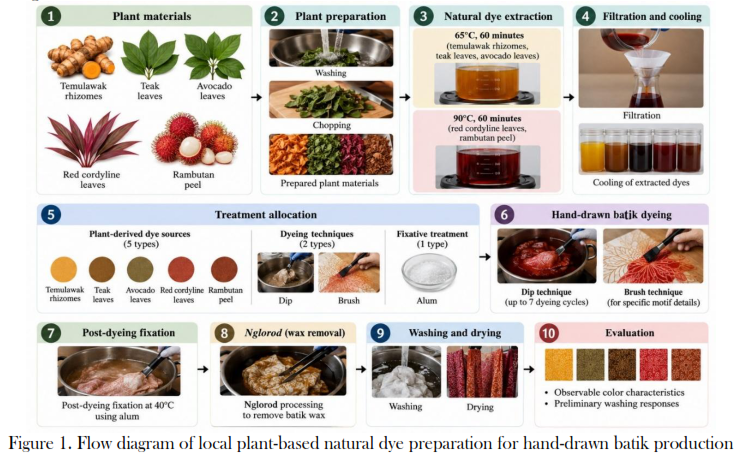
The use of synthetic dyes in the batik industry may contribute to environmental pollution due to chemical residues generated during the dyeing process. Therefore, natural dyes derived from local plants have attracted attention as alternative sources of textile colorants. This study aimed to examine the color characteristics of natural dyes derived from five local plant materials when applied to hand-drawn batik using different dyeing techniques. The study employed an exploratory experimental approach, with primary data obtained through natural dye extraction, batik preparation, dyeing, fixation, and preliminary washing evaluation. The natural dye sources consisted of temulawak rhizome (Curcuma xanthorrhiza Roxb.), teak leaves (Tectona grandis L.f.), red cordyline leaves (Cordyline fruticosa), rambutan peel (Nephelium lappaceum), and avocado leaves (Persea americana). The extracted dyes were applied to mori fabric using dip and brush dyeing techniques, followed by fixation with alum. The results showed that the plant-derived dyes produced different observable color characteristics. Temulawak produced yellowish shades, while teak and avocado leaves produced brownish shades. Red cordyline leaves and rambutan peel produced reddish to purplish or brownish tones. Alum-treated samples generally showed brighter and lighter shades based on visual observation. The preliminary washing evaluation showed that most samples maintained their basic color characteristics after water washing, although some samples showed reduced visual color intensity after detergent washing. These findings provide preliminary evidence of the varied color characteristics produced by local plant-derived dyes in hand-drawn batik. Further studies using instrumental color measurement and standardized textile fastness testing are needed to provide quantitative evaluation.
Downloads
References
Akbar, H. K., Muhimmatin, I., & Nugrahani, M. P. (2023). Keanekaragaman Tumbuhan Paku (Pteridophyta) Di Kawasan Wisata Air Terjun Kalibendo Banyuwangi. BIOEDUKASI (Jurnal Pendidikan Biologi), 14(1), 90–101. https://doi.org/10.24127/bioedukasi.v14i1.7777
Ariyanti, N. S., Hayati, N. S., & Hadisunarso. (2023). Potensi daun dari enam jenis tumbuhan sebagai pewarna alami untuk tekstil: The leaf potential of six plant species as natural dyes for textile. Jurnal Sumberdaya Hayati, 8(2), 65–74. https://doi.org/10.29244/jsdh.8.2.65-74
Afiatna, F. A. N. F., Muflihah, N., & Mayasari, A. (2024). Meningkatkan nilai produk batik yang ramah lingkungan dengan pewarnaan menggunakan sumber daya alam tumbuhan. Jurnal ABDINUS: Jurnal Pengabdian Nusantara, 8(1), 184–191. https://doi.org/10.29407/ja.v8i1.21336
Ayu Kusumawardani, S. D., Kurnani, T. B. A., Astari, A. J., & Sunardi, S. (2024). Readiness in implementing green industry standard for SMEs: Case of Indonesia’s batik industry. Heliyon, 10(16). https://doi.org/10.1016/j.heliyon.2024.e36045
Benli, H. (2024). Bio ‑ mordants : a review. Environmental Science and Pollution Research, 31(14), 20714–20771. https://doi.org/10.1007/s11356-024-32174-8
Bhandari, V., Badanayak, P., & Jose, S. (2024). Plant-Based Colorants: Isolation and Application. In Plant Biomass Derived Materials (pp. 159–188). https://doi.org/10.1002/9783527839032.ch7
Bukhari, M. N., Shabbir, M., Rather, L. J., Shahid, M., & Singh, U. (2017). Dyeing studies and fastness properties of brown naphtoquinone colorant extracted from Juglans regia L on natural protein fiber using different metal salt mordants. Textiles and Clothing Sustainability, 3(1), 3. https://doi.org/10.1186/s40689-016-0025-2
Damayanti, I., Evawati, D., & Nuraini, I. (2024). Hasil Ketahanan Pewarna Alami dari Ekstrak Daun Mangga dan Jati pada Katun. Bugaris, 1(2), 25–31. https://doi.org/10.36456/t77k8c19
Fadhila, A. N., Widayatno, T., & Haerudin, A. (2022). Pengaruh Variasi Jenis dan Konsentrasi Zat Fiksasi pada Ekstrak Daun Pepaya Sebagai Pewarna Alami pada Kain Batik. NARADA, Jurnal Desain & Seni, 9(3), 247–258. https://doi.org/10.2241/narada.2022.v9.i3.001
Failisnur, F., Sofyan, S., & Silfia, S. (2021). Colorimetric properties of batik fabrics colored using gambier liquid waste. Journal of Physics: Conference Series, 1940(1). https://doi.org/10.1088/1742-6596/1940/1/012092
Gecchele, E., Negri, S., Cauzzi, A., Cuccurullo, A., Commisso, M., Patrucco, A., Anceschi, A., Zaffani, G., & Avesani, L. (2021). Optimization of a sustainable protocol for the extraction of anthocyanins as textile dyes from plant materials. Molecules, 26(22), 6775. https://doi.org/10.3390/molecules26226775
Junita, Fauzi, A. M., Sunarti, T. C., & Yulianto, A. (2024). Prospects of The Development of The Sustainable Natural Textile Dye Industry : A Systematic Literature Review. In IOP Conference Series: Earth and Environmental Science, 1359(1). https://doi.org/10.1088/1755-1315/1359/1/012078
Ketapang, P. D., Mahoni, D., Bunga, D. A. N., & Kumalasari, V. (2016). Potensi daun ketapang, daun mahoni dan bunga kecombrang sebagai alternatif pewarnaan kain batik yang ramah lingkungan. 2(1), 62–70.
Khakim, A. L., & Widagdo, J. (2024). Zat pewarna alam sebagai alternatif pewarna batik. Corak: Jurnal Seni Kriya, 13(2), 111–124. https://doi.org/10.24821/corak.v13i2.13073
Kirana, A. A. (2021). Penggunaan Pewarna Kimia dalam Proses Pembuatan Batik. Folio, 2(1), 1–8. https://doi.org/ 10.37715/folio.v2i1.1873
Klinpikul, N., Dittapohn, S., Nakyai, W., & Keawbankrud, W. (2025). Optimization of eco-friendly mordant-assisted extraction and stability of natural pigments from six plant species for pressed paint development. Trends in Sciences, 22(9), 10316. https://doi.org/10.48048/tis.2025.10316
Maghfiroh, Q., Zaharani, Y., Tisna, M., & Putri, G. (2023). Seni Kerajinan Batik Tulis Lasem. Prosiding Konferensi Berbahasa Indonesia Universitas Indraprasta PGRI, 162–171. https://doi.org/ 10.30998/kibar.27-10-2022.6310
Martuti, N. K. T., Hidayah, I., Margunani, M., & Alafima, R. B. (2020). Organic material for clean production in the batik industry: A case study of natural batik Semarang, Indonesia. Recycling, 5(4), 1–13. https://doi.org/10.3390/recycling5040028
Mozaffari, E., & Maleki, B. (2018). Alum mineral and the importance for textile dyeing. Current Trends in Fashion Technology & Textile Engineering, 3(4), 85–87. https://doi.org/10.19080/CTFTTE.2018.03.555619
Oktyajati, N., Mayasari, S., Khaerudin, A., W, I. A. D. P., & Purwati, S. (2023). Pelestarian Warisan Budaya Batik Indonesia Melalui Workshop dan Seminar Pertukaran Budaya Dari Empat Negara Asia. Jurnal Pengabdian Kepada Masyarakat Sidoluhur, 03(02), 340–349.
Yuniati, Y., Handarini, K., & Rahmiati, R. (2024). Studi pustaka: Ekstraksi pewarna alami dari tanaman di Indonesia. Bioscientist: Jurnal Ilmiah Biologi, 12(1), 1099–1111. https://doi.org/10.33394/bioscientist.v12i1.11339
Faridah, F., Luthfiyati, D., Fatmawaty, R., Asrori, M., Sukardi, S., Septaria, K., & Zamroni, M. R. (2026). Peningkatan Kapasitas Publikasi Ilmiah Guru MIUS Lamongan melalui Pelatihan Pemetaan Bibliometrik dan Pendekatan Futures Thinking. Bhakti Nusantara: Jurnal Pengabdian Kepada Masyarakat, 2(1), 25-43.
Huda, M., Septaria, K., Rosdiana, S. R., Shafikha, R., & Salami, W. (2026). DEVELOPING AUGMENTED REALITY-BASED LEARNING MEDIA FOR TSUNAMI MITIGATION TO ADDRESS STUDENT MICRO-LEARNING CHALLENGES. JPPIPA (Jurnal Penelitian Pendidikan IPA), 11(1), 33-47.
Fatharani, A., Madlazim, M., Anggaryani, M., Satriawan, M., & Septaria, K. (2026). Learning from Earthquakes: The Role of Socio-Scientific Issues in Developing Students’ Science Argumentation Skills. Prisma Sains: Jurnal Pengkajian Ilmu dan Pembelajaran Matematika dan IPA IKIP Mataram, 14(1), 123-143.
Hendratmoko, A. F., Fauziah, A. N. M., Susiyawati, E., Astriani, D., Nurita, T., Martini, M., ... & Boey, A. (2026). Integrating ChatGPT-driven self-assessment and Debate Based on Inquiry Learning (DBOIL) to enhance students’ argumentation skills: Leveraging AI for quality science learning aligned with SDG 4. In E3S Web of Conferences (Vol. 696, p. 02005). EDP Sciences.
Septaria, K., Asrori, M., Setyo, C. Y., Faridah, F., Anam, M. K., Sukardi, S., & Kholiq, A. (2025). Pemberdayaan Guru Ma'arif melalui Pemanfaatan Deep Learning Engagement Tools untuk Peningkatan Literasi Digital dan Pedagogis. Bhakti Nusantara: Jurnal Pengabdian Kepada Masyarakat, 1(1), 25-39.
Septaria, K., Fatharani, A., & Baihaqi, A. (2025). Are Scrapbooks Able to Increase Tsunami Disaster Literacy? An Analytical Study of Junior High School Students Materials. SEJ (Science Education Journal), 9(2), 115-133. https://doi.org/10.21070/sej.v9i2.1656
Septaria, K., Fatharani, A., Supardi, Z. A. I., Suyono, S., & Regita, M. A. (2025). Pengembangan Sikap Ilmiah Abad 21 Melalui Lembar Kerja Berbasis Teori Pembelajaran Sosial pada Materi Listrik Statis. Jurnal Penelitian Sains dan Pendidikan (JPSP), 5(1), 65-86. https://doi.org/10.23971/jpsp.v5i1.9758
Sho'idah, Y., Septaria, K., & Wulandari, S. A. (2025). Analysis of Student Scientific Communication Based on The Development and Use of Diorama Media Using The Guided Inquiry Model. Reforma: Jurnal Pendidikan dan Pembelajaran, 15(1), 24-47. https://doi.org/10.30736/reforma.v15i1.1207
Hendratmoko, A. F., Puspitarini, S., Budiyanto, M., Rahman, N., Septaria, K., & Marpuah, S. (2025). Think-Aloud Protocol as a Method for Exploring and Understanding the Argumentation Skills of Pre-Service Science Teachers. Prisma Sains: Jurnal Pengkajian Ilmu dan Pembelajaran Matematika dan IPA IKIP Mataram, 13(2), 268-282. https://doi.org/10.33394/j-ps.v13i2.15214
Septaria, K., Fatharani, A., Dewanti, B. A., & Najawa, W. C. (2024). Designing Pirposal-learning based Module integrated with Socio-Scientific Issue to Enhance Students’ Scientific Reasoning Skill. Indonesian Journal of Mathematics and Natural Science Education, 5(2), 122-134. https://doi.org/10.35719/mass.v5i2.162
Septaria, K., Nissak, K., & Wulandari, S. A. (2023). Student Identity and Guided Inquiry Learning in Junior High School Students: A Correlation Analysis. Jurnal Penelitian Pendidikan IPA, 9(10), 8351-8358. https://doi.org/10.29303/jppipa.v9i10.4584
Septaria, K., Dewanti, B. A., & El Afidah, M. I. (2020). Development of module disaster mitigation based on STEM for secondary schools. JPPIPA (Jurnal Penelitian Pendidikan IPA), 5(2), 61-68. https://doi.org/10.26740/jppipa.v5n2.p61-68
Septaria, K. (2019). Mengeksplorasi Argumentasi dan Pengetahuan Pendidik Ilmu Pengetahuan Alam (IPA) tentang Pemanasan Global. PEDAGOGIA: Jurnal Pendidikan, 8(2), 247-256. https://doi.org/10.21070/pedagogia.v8i2.2369
Septaria, K., & Fatharani, A. (2022). Analisis Penggunaan Software PlantNet Terhadap Pemerolehan Konsep Dan Keterampilan Prosedural Siswa. Indonesian Journal of Educational Science (IJES), 5(1), 73-83. https://doi.org/10.31605/ijes.v5i1.1604
Septaria, K., Dewanti, B. A., & Habibbulloh, M. (2019). Implementasi metode pembelajaran spot capturing pada materi pemanasan global untuk meningkatkan keterampilan proses sains. Prisma Sains: Jurnal Pengkajian Ilmu dan Pembelajaran Matematika dan IPA IKIP Mataram, 7(1), 27-37. https://doi.org/10.33394/j-ps.v0i0.1379
Septaria, K., & Fatharani, A. (2022). Manga versus webtoon: Alternative science learning module based on Dr Stone. Jurnal Inovasi Pendidikan IPA, 8(1), 11-22. https://doi.org/10.21831/jipi.v8i1.43389
Septaria, K., & Haque, E. H. (2022). Upaya Peningkatan Pengetahuan Masyarakat terhadap Covid-19 Menggunakan Media Poster. TAAWUN, 2(02), 115-124.
Septaria, K., Sholihin, M., Kholiq, A., Hayati, E., & Maulana, V. I. P. (2022). Peningkatan Kualitas Pendidik dan Pembelajaran Menuju Madrasah yang Ungggul dan Berkelanjutan. Jurnal Berdaya Mandiri, 4(2), 167-181. https://doi.org/10.31316/jbm.v4i2.1742
Downloads
Published
How to Cite
Issue
Section
License
Copyright (c) 2026 Yeni Widiyawati, Selfia Nur Anggraeni, Revista Arbani Maulida, Naila Salwa

This work is licensed under a Creative Commons Attribution-ShareAlike 4.0 International License.
Authors who publish with this journal agree to the following terms:
- Authors retain copyright and grant the journal right of first publication with the work simultaneously licensed under a Creative Commons Attribution-ShareAlike 4.0 International License that allows others to share the work with an acknowledgment of the work's authorship and initial publication in this journal.
- Authors are able to enter into separate, additional contractual arrangements for the non-exclusive distribution of the journal's published version of the work (e.g., post it to an institutional repository or publish it in a book), with an acknowledgment of its initial publication in this journal.
- Authors are permitted and encouraged to post their work online (e.g., in institutional repositories or on their website) prior to and during the submission process, as it can lead to productive exchanges, as well as earlier and greater citation of published work (See The Effect of Open Access).

This work is licensed under a Creative Commons Attribution-ShareAlike 4.0 International License.