Comparing Perceived Learning Interest and Perceived Achievement Between Users and Non-Users of Ruangguru: An Exploratory Cross-Sectional Survey
DOI:
https://doi.org/10.30736/reforma.v16i2.1488Keywords:
Teacher's Room, Learning Interests, Perceived Achievement, Digital Learning Platforms, Student PerceptionAbstract
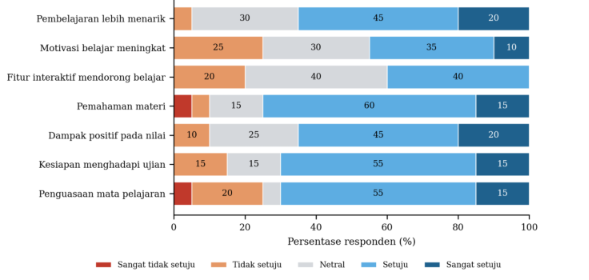
Studies of Ruangguru mostly examine a single group of students and sometimes use causal wording, while comparisons of users and non-users on perceived outcomes within the same survey are scarce. This exploratory study aimed to describe students’ perceived learning interest and perceived achievement, to compare them between Ruangguru users and non-users, and to examine their association. A cross-sectional descriptive-correlational online survey was conducted on 9–20 December 2024 using snowball sampling among students in East Java (N = 20 analysed). Respondents who currently or previously used Ruangguru (n = 16) were compared with those who had never used it (n = 4). Seven five-point Likert items measured perceived learning interest (three items; α = 0.776) and perceived achievement (four items; α = 0.892), and data were analysed with the Mann–Whitney U test and Spearman’s rank correlation. Users reported higher perceived learning interest (M = 3.67 vs. 2.50; U = 62.5, p = 0.004, |r_rb| = 0.95) and higher perceived achievement (M = 4.03 vs. 2.31; U = 63.0, p = 0.004, |r_rb| = 0.97) than non-users, and the two perceptions were positively correlated (ρ = 0.784, p < 0.001). Interactive features received the lowest agreement (40%). These results indicate associations, not effects of Ruangguru. The sample was small, non-random, and limited to East Java, the non-user group had only four respondents so effect sizes are unstable, and both constructs were self-reported at one time point. The findings are therefore preliminary and call for larger samples, validated instruments, and objective learning outcomes.
Downloads
References
Baars, M., Khare, S., & Ridderstap, L. (2022). Exploring students' use of a mobile application to support their self-regulated learning processes. Frontiers in Psychology, 13, Article 793002. https://doi.org/10.3389/fpsyg.2022.793002
Fadhillah, RA, Riyanto, MFP, Alfarouk, MG, & Wildan, R. (2025). The effect of using the Ruangguru platform on offline learning motivation in Indonesian language subjects at the Indonesian University of Education. Indonesian Education Star Journal, 3(2). https://doi.org/10.55606/jubpi.v3i2.3854
Hidi, S., & Renninger, K. A. (2006). The four-phase model of interest development. Educational Psychologist, 41(2), 111–127. https://doi.org/10.1207/s15326985ep4102_4
Khanifah, A., & Pribadi, F. (2022). The role of the Ruang Guru application in increasing students' interest in learning during the COVID-19 pandemic. Joyful Learning Journal, 11(3), 92–99. https://doi.org/10.15294/jlj.v11i3.52201
Kusuma, FI, Suryani, N., & Sumaryati, S. (2022). Mobile application-based media learning and its' effect on students' learning motivation. International Journal of Evaluation and Research in Education, 11(3), 1353–1359. https://doi.org/10.11591/ijere.v11i3.22481
Liriwati, FY (2023). The digital revolution and independent learning: Improving student competitiveness in the technological era. INOVED, 1(3). https://doi.org/10.59841/inoved.v1i3.284
Pantow, DP, & Korompis, FLS (2024). The effect of learning applications on increasing motivation and learning activities of high school students in Ruangguru tutoring. Journal of Learning and Technology, 3(1), 48–57. https://doi.org/10.33830/jlt.v3i1.9859
Pradana, M., & Syarifuddin, S. (2021). The struggle is real: Constraints of online education in Indonesia during the COVID-19 pandemic. Frontiers in Education, 6, Article 753776. https://doi.org/10.3389/feduc.2021.753776
Pratiwi, E., Harjono, HS, & Wulandari, BA (2021). The effect of using the Ruangguru application and motivation on the physics learning outcomes of class X students at Muhammadiyah Vocational High School, Jambi City. JMPIS: Journal of Educational Management and Social Sciences, 2(2). https://doi.org/10.38035/jmpis.v2i2.651
Prillya, CR, Gani, SA, & Marhaban, S. (2021). An investigation of Ruangguru media as an educational online platform in studying English. English Education Journal, 12(1), 89–103. https://doi.org/10.24815/eej.v12i1.17440
Ritiauw, SP, Mahananingtyas, E., Salamor, L., & Sayang, NK (2022). Utilization of the Ruang Guru application assisted by Zoom Cloud Meeting to improve elementary school student learning outcomes. Research and Development Journal of Education, 8(1). https://doi.org/10.30998/rdje.v8i1.10645
Rizqiah, A., Mansur, H., & Sufyadi, S. (2023). Utilization of Ruangguru e-learning as a learning medium to improve biology learning outcomes of 11th grade students at SMA Negeri 10 Banjarmasin. Journal of Instructional Technology, 3(2), 1–8. https://doi.org/10.20527/j-instech.v3i2.8686
Ryan, R. M., & Deci, E. L. (2000). Self-determination theory and the facilitation of intrinsic motivation, social development, and well-being. American Psychologist, 55(1), 68–78. https://doi.org/10.1037/0003-066X.55.1.68
Schober, P., Boer, C., & Schwarte, L. A. (2018). Correlation coefficients: Appropriate use and interpretation. Anesthesia & Analgesia, 126(5), 1763–1768. https://doi.org/10.1213/ANE.0000000000002864
Septaria, K., Nadhiroh, S., Setyaningsih, S., Dewanti, B. A., Asy'ad, W. A., & Sa'diyyah, L. (2026). Penerapan Model Predict-Observe-Explain untuk Mengembangkan Keterampilan Pemecahan Masalah Pada Materi Klasifikasi Materi. Edukimbiosis: Jurnal Pendidikan IPA, 5(1), 28-49.
Faridah, F., Luthfiyati, D., Fatmawaty, R., Asrori, M., Sukardi, S., Septaria, K., & Zamroni, M. R. (2026). Peningkatan Kapasitas Publikasi Ilmiah Guru MIUS Lamongan melalui Pelatihan Pemetaan Bibliometrik dan Pendekatan Futures Thinking. Bhakti Nusantara: Jurnal Pengabdian Kepada Masyarakat, 2(1), 25-43.
Huda, M., Septaria, K., Rosdiana, S. R., Shafikha, R., & Salami, W. (2026). DEVELOPING AUGMENTED REALITY-BASED LEARNING MEDIA FOR TSUNAMI MITIGATION TO ADDRESS STUDENT MICRO-LEARNING CHALLENGES. JPPIPA (Jurnal Penelitian Pendidikan IPA), 11(1), 33-47.
Fatharani, A., Madlazim, M., Anggaryani, M., Satriawan, M., & Septaria, K. (2026). Learning from Earthquakes: The Role of Socio-Scientific Issues in Developing Students’ Science Argumentation Skills. Prisma Sains: Jurnal Pengkajian Ilmu dan Pembelajaran Matematika dan IPA IKIP Mataram, 14(1), 123-143.
Septaria, K., Asrori, M., Setyo, C. Y., Faridah, F., Anam, M. K., Sukardi, S., & Kholiq, A. (2025). Pemberdayaan Guru Ma'arif melalui Pemanfaatan Deep Learning Engagement Tools untuk Peningkatan Literasi Digital dan Pedagogis. Bhakti Nusantara: Jurnal Pengabdian Kepada Masyarakat, 1(1), 25-39.
Khasanah, S. N., Septaria, K., & Rosdiana, S. R. (2025). Developmet Of WE-ARe Based Teaching Modules on Flood Disaster Mitigation Material to Train Students' Scientific Literacy. Indonesian Journal of Mathematics and Natural Science Education, 6(2), 142-158.
Septaria, K., Fatharani, A., & Baihaqi, A. (2025). Are Scrapbooks Able to Increase Tsunami Disaster Literacy? An Analytical Study of Junior High School Students Materials. SEJ (Science Education Journal), 9(2), 115-133. https://doi.org/10.21070/sej.v9i2.1656
Septaria, K., Fatharani, A., Supardi, Z. A. I., Suyono, S., & Regita, M. A. (2025). Pengembangan Sikap Ilmiah Abad 21 Melalui Lembar Kerja Berbasis Teori Pembelajaran Sosial pada Materi Listrik Statis. Jurnal Penelitian Sains dan Pendidikan (JPSP), 5(1), 65-86. https://doi.org/10.23971/jpsp.v5i1.9758
Sho'idah, Y., Septaria, K., & Wulandari, S. A. (2025). Analysis of Student Scientific Communication Based on The Development and Use of Diorama Media Using The Guided Inquiry Model. Reforma: Jurnal Pendidikan dan Pembelajaran, 15(1), 24-47. https://doi.org/10.30736/reforma.v15i1.1207
Hendratmoko, A. F., Puspitarini, S., Budiyanto, M., Rahman, N., Septaria, K., & Marpuah, S. (2025). Think-Aloud Protocol as a Method for Exploring and Understanding the Argumentation Skills of Pre-Service Science Teachers. Prisma Sains: Jurnal Pengkajian Ilmu dan Pembelajaran Matematika dan IPA IKIP Mataram, 13(2), 268-282. https://doi.org/10.33394/j-ps.v13i2.15214
Septaria, K., Fatharani, A., Dewanti, B. A., & Najawa, W. C. (2024). Designing Pirposal-learning based Module integrated with Socio-Scientific Issue to Enhance Students’ Scientific Reasoning Skill. Indonesian Journal of Mathematics and Natural Science Education, 5(2), 122-134. https://doi.org/10.35719/mass.v5i2.162
Septaria, K., Nissak, K., & Wulandari, S. A. (2023). Student Identity and Guided Inquiry Learning in Junior High School Students: A Correlation Analysis. Jurnal Penelitian Pendidikan IPA, 9(10), 8351-8358. https://doi.org/10.29303/jppipa.v9i10.4584
Septaria, K., Dewanti, B. A., & El Afidah, M. I. (2020). Development of module disaster mitigation based on STEM for secondary schools. JPPIPA (Jurnal Penelitian Pendidikan IPA), 5(2), 61-68. https://doi.org/10.26740/jppipa.v5n2.p61-68
Septaria, K. (2019). Mengeksplorasi Argumentasi dan Pengetahuan Pendidik Ilmu Pengetahuan Alam (IPA) tentang Pemanasan Global. PEDAGOGIA: Jurnal Pendidikan, 8(2), 247-256. https://doi.org/10.21070/pedagogia.v8i2.2369
Septaria, K., & Fatharani, A. (2022). Analisis Penggunaan Software PlantNet Terhadap Pemerolehan Konsep Dan Keterampilan Prosedural Siswa. Indonesian Journal of Educational Science (IJES), 5(1), 73-83. https://doi.org/10.31605/ijes.v5i1.1604
Septaria, K., Dewanti, B. A., & Habibbulloh, M. (2019). Implementasi metode pembelajaran spot capturing pada materi pemanasan global untuk meningkatkan keterampilan proses sains. Prisma Sains: Jurnal Pengkajian Ilmu dan Pembelajaran Matematika dan IPA IKIP Mataram, 7(1), 27-37. https://doi.org/10.33394/j-ps.v0i0.1379
Septaria, K., & Fatharani, A. (2022). Manga versus webtoon: Alternative science learning module based on Dr Stone. Jurnal Inovasi Pendidikan IPA, 8(1), 11-22. https://doi.org/10.21831/jipi.v8i1.43389
Septaria, K., & Haque, E. H. (2022). Upaya Peningkatan Pengetahuan Masyarakat terhadap Covid-19 Menggunakan Media Poster. TAAWUN, 2(02), 115-124.
Septaria, K., Sholihin, M., Kholiq, A., Hayati, E., & Maulana, V. I. P. (2022). Peningkatan Kualitas Pendidik dan Pembelajaran Menuju Madrasah yang Ungggul dan Berkelanjutan. Jurnal Berdaya Mandiri, 4(2), 167-181. https://doi.org/10.31316/jbm.v4i2.1742
Taber, K.S. (2018). The use of Cronbach's alpha when developing and reporting research instruments in science education. Research in Science Education, 48, 1273–1296. https://doi.org/10.1007/s11165-016-9602-2
Wisniewski, B., Zierer, K., & Hattie, J. (2020). The power of feedback revisited: A meta-analysis of educational feedback research. Frontiers in Psychology, 10, Article 3087. https://doi.org/10.3389/fpsyg.2019.03087
Yendi, MS, & Hayati, AF (2020). The influence of online tutoring (Ruangguru) and learning interest on the economics learning outcomes of class X students at SMA Negeri 3 Padang. Ecogen Journal, 3(1). https://doi.org/10.24036/jmpe.v3i1.8528
Downloads
Published
How to Cite
Issue
Section
License
Copyright (c) 2026 Achmad Faried Irfany, Hendri Irawan, Steven Karunia Adi, Ahmad Fardan Alman, Ahmad Nabil Nashiri

This work is licensed under a Creative Commons Attribution-ShareAlike 4.0 International License.
Penulis yang mempublikasikan naskahnya pada Jurnal ini menyetujui ketentuan berikut:
- Hak cipta pada setiap artikel adalah milik penulis, dan penulis mengakui bahwa Reforma : Jurnal Pendidikan dan Pembelajaran berhak sebagai pihak yang mempublikasikan pertama kali dengan lisensi Attribution-ShareAlike 4.0 International (CC BY-SA 4.0).
- Lisensi ini mengizinkan setiap orang untuk:
- Berbagi — menyalin dan menyebarluaskan kembali materi ini dalam bentuk atau format apapun;
- Adaptasi — menggubah, mengubah, dan membuat turunan dari materi ini untuk kepentingan apapun, termasuk kepentingan komersial.
Berdasarkan ketentuan berikut:
- Atribusi —Mereka harus mencantumkan nama yang sesuai, mencantumkan tautan terhadap lisensi, dan menyatakan bahwa telah ada perubahan yang dilakukan. Mereka dapat melakukan hal ini dengan cara yang sesuai, namun tidak mengisyaratkan bahwa pemberi lisensi mendukung Mereka atau penggunaan Mereka.
- BerbagiSerupa — Apabila Mereka menggubah, mengubah, atau membuat turunan dari materi ini, Mereka harus menyebarluaskan kontribusi Mereka di bawah lisensi yang sama dengan materi asli.
- Tidak ada pembatasan tambahan — Mereka tidak dapat menggunakan ketentuan hukum atau sarana kontrol teknologi yang secara hukum membatasi orang lain untuk melakukan hal-hal yang diizinkan lisensi ini.
- Penulis dapat memasukan tulisan secara terpisah, mengatur distribusi non-ekskulif  dari naskah yang telah terbit di jurnal ini kedalam versi yang lain (misal: dikirim ke respository institusi penulis, publikasi kedalam buku, dll), dengan mengakui bahwa naskah telah terbit pertama kali pada Reforma : Jurnal Pendidikan dan Pembelajaran