Bridging Islamic Values and Mathematical Habits of Mind: A Systematic Review of Character Development in Mathematics Education
DOI:
https://doi.org/10.30736/reforma.v16i2.1482Keywords:
Character Development, Islamic Values, Mathematical Habits of Mind, Mathematics Education, Systematic Literature ReviewAbstract
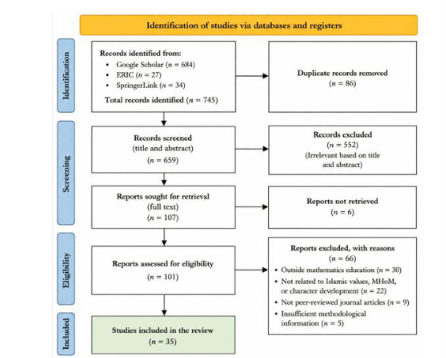
The integration of Islamic values into mathematics education has been explored as an approach to character development, yet the conceptual relationship between Islamic values and Mathematical Habits of Mind (MHoM) remains insufficiently specified. In particular, it is unclear how specific Islamic values correspond to mathematical dispositions and how these dispositions may provide opportunities for enacting values in ways relevant to character development. This study systematically reviewed the literature to map these relationships and develop an integrated conceptual framework. Following PRISMA guidelines, a systematic literature review was conducted using Google Scholar, ERIC, and Springer, resulting in 35 studies published between 2015 and February 2026. The studies were manually coded and thematically synthesized to identify recurring Islamic values, MHoM dimensions, and their conceptual relationships with character development. Six Islamic values emerged: ṣidq, amānah, istiqāmah, mujāhadah, tafakkur, and muḥāsabah. Among MHoM dimensions, persistence/perseverance was most frequently identified (10 studies; 28.6%), followed by reflective thinking/metacognition and reasoning/justification (eight studies each; 22.9%). However, only three studies (8.6%) explicitly examined the combined relationship among Islamic values, MHoM, and character development. The synthesis suggests that existing research more often addresses value integration or MHoM separately than investigates their intersection. The proposed framework explains Islamic values as the ethical–spiritual orientation of mathematical activity, MHoM as the dispositions through which these values may be enacted, and character development as a potential outcome of sustained enactment and reflection. By distinguishing these complementary roles, the framework provides a basis for designing and empirically testing mathematics education that connects mathematical thinking with ethical–spiritual character development.
Downloads
References
Andriani, S., Yulianti, K., Ferdias, P., & Fatonah, S. (2017). The Effect of Mathematical Habits of Mind Learning Strategy Based on Problem Toward St Udents ’ Mathematical Creative Thinking Disposition. IJAEDU- International E-Journal of Advances in Education, III(9), 689–696.
Ariawan, R., Dahlia, A., Nufus, H., & Nurdin, E. (2022). Analysis of Mathematical Critical Thinking Ability viewed from Habits of Mind. Jurnal Pendidikan MIPA, 23(20), 904–917. https://doi.org/http://dx.doi.org/10.23960/jpmipa/v23i3.pp904-917
Arizona, K., Rokhmat, J., Ramdani, A., & Sukarso, A. A. (2025). Integrating Islamic Values And Local Wisdom Into Science Education: Enhancing Character Development in Higher Education. Ulumuna, 29(1), 398–428.
Ayyubi, I. I. Al, Handayani, R. A., & Putri, N. D. V. (2026). Integrating Mathematics and Islamic Da’wah in Education: Bridging the Gap Between Science and Religious Values. Al-Bustan: Jurnal Pendidikan Islam, 3(1), 40–68. https://doi.org/10.62448/ajpi.v3i1.552
Dwirahayu, G., Kustiawati, D., & Bidari, I. (2017). Corresponding Habits of Mind and Mathematical Ability. Journal of Physics: Conference Series, 895(1). https://doi.org/10.1088/1742-6596/895/1/012013
Gordon, M. (2011). Mathematical habits of mind : Promoting students ’ thoughtful considerations. Journal of Curriculum Studies, 43(4), 457–469. https://doi.org/10.1080/00220272.2011.578664
Hadi, S., Hartono, H., & Rachmadtullah, R. (2025). Teachers’ Understanding of The Integration of Islamic Values in Mathematics Learning in Elementary Schools. Eduprof : Islamic Education Journal. https://doi.org/10.47453/eduprof.v6i2.343
Hadi, S., & Rachmadtullah, R. (2025). Teachers ’ Understanding of The Integration of Islamic Values in Mathematics Learning in Elementary Schools. Eduprof: Islamic Education Journal, 6(2), 172–181. https://doi.org/https://doi.org/10.47453/eduprof.v6i2.343
Hafni, R. N., Sari, D. M., & Nurlaelah, E. (2019). Analyzing theeffect of students ’ habits of mind to mathematical critical thinking skill. Journal of Physics: Conference Series, 1211(012074), 1–9. https://doi.org/10.1088/1742-6596/1211/1/012074
Hasibuan, V. A. P., Mariana, N., & Ekawati, R. (2024). Literature Study: Elementary School Mathematics Learning with Islamic Integration. International Journal of Emerging Research and Review, 2(1), 1–11. https://doi.org/10.56707/ijoerar.v2i2.71
Hidayati, L. A., Kusno, K., & Alam, M. (2026). Integrating Prophetic Values in Mathematics Learning: Enhancing Connection Abilities and Islamic Character in Middle Schools. Jurnal Pendidikan MIPA. https://doi.org/10.23960/jpmipa.v27i1.pp632-655
Hifzhi, H., Asmar, A., Fauzan, A., & Jamaan, E. (2024). Enhancing student learning motivation: Developing an integrated mathematics module with islamic values. Al-Jabar : Jurnal Pendidikan Matematika, 15(1), 131–144. https://doi.org/10.24042/ajpm.v15i1.21980
Ikhwan, A. (2025). Integration of Islamic Values in Character Education : A Case Study at Madrasah Salafiyah. Jurnal Pendidikan Nusantara, 4(2), 63–73. https://doi.org/http://doi.org/10.55080/jpn.v4i2.199
Ilma, R., Putri, I., & Aisyah, N. (2020). Learning Integers With Realistic Mathematics Education Approach Based On Islamic Values. Journal on Mathematics Education, 11(3), 363–384. https://doi.org/http://doi.org/10.22342/jme.11.3.11721.363-384
Indriani, T., & Retnawati, H. (2025). The Effect of Habits of Mind on Students ’ Reasoning Ability through Mathematic Connections. JURNAL ILMIAH PENDIDIKAN PROFESI GURU, 8(2), 293–306. https://doi.org/http://dx.doi.org/10.23887/jippg.v8i2.102173
Johar, R., Ikhsan, M., Idami, Z., Khairunnisak, C., Ellianti, E., Rohaizati, U., & Ghazali, M. (2025). Enhancing mathematical communication and Islamic values in Islamic and regular schools through interactive worksheets. Front. Educ, 10(1633056), 1–16. https://doi.org/10.3389/feduc.2025.1633056
Lestari, F., Farid, F., Syazali, M., Putra, F. G., Maulidi, I., & Apriliani, V. (2025). Integration of Qur’anic Values in Mathematics Learning: A Bibliometric Analysis. Islamic Journal of Integrated Science Education (IJISE). https://doi.org/10.30762/ijise.v4i2.5921
Maarif, S., & Fitriani, N. (2023). Mathematical Resilience, Habits Of Mind, And Sociomathematical Norms By Senior High School Students In Learning Mathematics: A Structured Equation Model. Infinity Journal of Mathematics Education, 12(1), 117–132. https://doi.org/https://doi.org/10.22460/infinity.v12i1.p117-132
Mahmudah, I., & Muqowim, M. (2022). Integration Of Islamic Values In Mathematics Learning In Class IV Students Of Madrasah Ibtidaiyah. Al-Madrasah: Jurnal Pendidikan Madrasah Ibtidaiyah. https://doi.org/10.35931/am.v6i4.1143
Mahmudah, I., Uin, M., & Kalijaga, S. (2022). Integration of Islamic Values In Mathematics Learning In Class Iv Students of Madrasah Ibtidaiyah. Al-Madrasah : Jurnal Ilmiah Pendidikan Madrasah Ibtidaiyah, 6(4), 1075–1087. https://doi.org/10.35931/am.v6i4.
Nurhikmah, Ayyubi, I. I. Al, Prayetno, E., Jamaliah, D., & Mumtazah, N. (2024). Equilibrium of Faith and Logic: Integrating Islamic Moral Values and Mathematics Education in Various Contexts. International Journal of Education Management and Religion. https://doi.org/10.71305/ijemr.v1i2.167
Nurhikmah, N., Imam, I., Ayyubi, A., Prayetno, E., Jamaliah, D., & Mumtazah, N. (2024). Equilibrium of Faith and Logic : Integration of Islamic Moral Values and Mathematics Education at the Junior High School Level in Various Contexts. IJEMR: International Journal of Education Management and Religion, 1(2), 127–144.
Pei, C. Y., Weintrop, D., Wilensky, U., & Pei, C. Y. (2018). Cultivating Computational Thinking Practices and Mathematical Habits of Mind in Lattice Land Cultivating Computational Thinking Practices and Mathematical Habits of Mind in Lattice Land. Mathematical Thinking and Learning, 20(1), 75–89. https://doi.org/10.1080/10986065.2018.1403543
Purnomo, Y. W., Nabilllah, R., Aziz, T. A., & Widodo, S. A. (2024). Fostering mathematical connections and habits of mind: a problem-based learning module for elementary education. Infinity Journal of Mathematics Education, 13(2), 333–348. https://doi.org/https://doi.org/10.22460/infinity.v13i2.p333-348
Putra, A. L. T., Ayyubi, I. I. Al, Ridho, R., & Habibi, M. (2026). Toward an Islamic Values Framework for Mathematics Education: Evidence from Classroom Practices. Al-Bustan: Jurnal Pendidikan Islam, 3(1), 16–20. https://doi.org/10.62448/ajpi.v3i1.551
Rahmah, N., Tahmir, S., & Tiro, M. A. (2022). Students ’ Mathematics Learning Model in the Integration of Character Value ( PMT-Character ). Asian Journal of Applied Sciences (ISSN:, 10(4), 337–344.
Riwanda, A., Evita, A., Syatria, W., & Pranajaya, A. (2025). Science and Religion Integration in Indonesian Islamic Senior High Schools : Analyzing Teachers ’ Pedagogical Practices. Science & Education, 35(1), 261–281. https://doi.org/10.1007/s11191-025-00648-x
Rizal, S., Nahar, S., & Farabi, M. Al. (2023). Islamic Values: Integration in Learning Mathematics and Science at Man 2 Level 2022/2023 Academic Year. Munaddhomah: Jurnal Manajemen Pendidikan Islam, 4(3), 732–745. https://doi.org/10.31538/munaddhomah.v4i3.653
Salam, S. M., Baharullah, B., & Mukhlis, M. (2025). Developing E-Module Integrated of Islamic Values in Mathematics Learning: A Study Three-Dimensional Material. Jurnal Inovasi Pendidikan Dan Sains. https://doi.org/10.51673/jips.v6i2.2502
Setiawan, S., Idris, S., & Daud, A. H. M. (2025). Developing Students ’ Character Through the Integration of Islamic Values in Mathematics Learning. Electronic Journal of Education, Social Economic and Technology, 6(2), 1–9. https://doi.org/https://doi.org/10.33122/ejeset.v6i2.945
Setiawan, S., Walidin, W., Ali, Z., & Siregar, B. (2025). Revitalization of Islamic Values-Based Curriculum : Integration of Religious Education in Mathematics Learning. Electronic Journal of Education, Social Economic and Technology, 6(2), 1–10.
Septaria, K., Nadhiroh, S., Setyaningsih, S., Dewanti, B. A., Asy'ad, W. A., & Sa'diyyah, L. (2026). Penerapan Model Predict-Observe-Explain untuk Mengembangkan Keterampilan Pemecahan Masalah Pada Materi Klasifikasi Materi. Edukimbiosis: Jurnal Pendidikan IPA, 5(1), 28-49.
Faridah, F., Luthfiyati, D., Fatmawaty, R., Asrori, M., Sukardi, S., Septaria, K., & Zamroni, M. R. (2026). Peningkatan Kapasitas Publikasi Ilmiah Guru MIUS Lamongan melalui Pelatihan Pemetaan Bibliometrik dan Pendekatan Futures Thinking. Bhakti Nusantara: Jurnal Pengabdian Kepada Masyarakat, 2(1), 25-43.
Huda, M., Septaria, K., Rosdiana, S. R., Shafikha, R., & Salami, W. (2026). DEVELOPING AUGMENTED REALITY-BASED LEARNING MEDIA FOR TSUNAMI MITIGATION TO ADDRESS STUDENT MICRO-LEARNING CHALLENGES. JPPIPA (Jurnal Penelitian Pendidikan IPA), 11(1), 33-47.
Fatharani, A., Madlazim, M., Anggaryani, M., Satriawan, M., & Septaria, K. (2026). Learning from Earthquakes: The Role of Socio-Scientific Issues in Developing Students’ Science Argumentation Skills. Prisma Sains: Jurnal Pengkajian Ilmu dan Pembelajaran Matematika dan IPA IKIP Mataram, 14(1), 123-143.
Septaria, K., Asrori, M., Setyo, C. Y., Faridah, F., Anam, M. K., Sukardi, S., & Kholiq, A. (2025). Pemberdayaan Guru Ma'arif melalui Pemanfaatan Deep Learning Engagement Tools untuk Peningkatan Literasi Digital dan Pedagogis. Bhakti Nusantara: Jurnal Pengabdian Kepada Masyarakat, 1(1), 25-39.
Khasanah, S. N., Septaria, K., & Rosdiana, S. R. (2025). Developmet Of WE-ARe Based Teaching Modules on Flood Disaster Mitigation Material to Train Students' Scientific Literacy. Indonesian Journal of Mathematics and Natural Science Education, 6(2), 142-158.
Septaria, K., Fatharani, A., & Baihaqi, A. (2025). Are Scrapbooks Able to Increase Tsunami Disaster Literacy? An Analytical Study of Junior High School Students Materials. SEJ (Science Education Journal), 9(2), 115-133. https://doi.org/10.21070/sej.v9i2.1656
Septaria, K., Fatharani, A., Supardi, Z. A. I., Suyono, S., & Regita, M. A. (2025). Pengembangan Sikap Ilmiah Abad 21 Melalui Lembar Kerja Berbasis Teori Pembelajaran Sosial pada Materi Listrik Statis. Jurnal Penelitian Sains dan Pendidikan (JPSP), 5(1), 65-86. https://doi.org/10.23971/jpsp.v5i1.9758
Sho'idah, Y., Septaria, K., & Wulandari, S. A. (2025). Analysis of Student Scientific Communication Based on The Development and Use of Diorama Media Using The Guided Inquiry Model. Reforma: Jurnal Pendidikan dan Pembelajaran, 15(1), 24-47. https://doi.org/10.30736/reforma.v15i1.1207
Hendratmoko, A. F., Puspitarini, S., Budiyanto, M., Rahman, N., Septaria, K., & Marpuah, S. (2025). Think-Aloud Protocol as a Method for Exploring and Understanding the Argumentation Skills of Pre-Service Science Teachers. Prisma Sains: Jurnal Pengkajian Ilmu dan Pembelajaran Matematika dan IPA IKIP Mataram, 13(2), 268-282. https://doi.org/10.33394/j-ps.v13i2.15214
Septaria, K., Fatharani, A., Dewanti, B. A., & Najawa, W. C. (2024). Designing Pirposal-learning based Module integrated with Socio-Scientific Issue to Enhance Students’ Scientific Reasoning Skill. Indonesian Journal of Mathematics and Natural Science Education, 5(2), 122-134. https://doi.org/10.35719/mass.v5i2.162
Septaria, K., Nissak, K., & Wulandari, S. A. (2023). Student Identity and Guided Inquiry Learning in Junior High School Students: A Correlation Analysis. Jurnal Penelitian Pendidikan IPA, 9(10), 8351-8358. https://doi.org/10.29303/jppipa.v9i10.4584
Septaria, K., Dewanti, B. A., & El Afidah, M. I. (2020). Development of module disaster mitigation based on STEM for secondary schools. JPPIPA (Jurnal Penelitian Pendidikan IPA), 5(2), 61-68. https://doi.org/10.26740/jppipa.v5n2.p61-68
Septaria, K. (2019). Mengeksplorasi Argumentasi dan Pengetahuan Pendidik Ilmu Pengetahuan Alam (IPA) tentang Pemanasan Global. PEDAGOGIA: Jurnal Pendidikan, 8(2), 247-256. https://doi.org/10.21070/pedagogia.v8i2.2369
Septaria, K., & Fatharani, A. (2022). Analisis Penggunaan Software PlantNet Terhadap Pemerolehan Konsep Dan Keterampilan Prosedural Siswa. Indonesian Journal of Educational Science (IJES), 5(1), 73-83. https://doi.org/10.31605/ijes.v5i1.1604
Septaria, K., Dewanti, B. A., & Habibbulloh, M. (2019). Implementasi metode pembelajaran spot capturing pada materi pemanasan global untuk meningkatkan keterampilan proses sains. Prisma Sains: Jurnal Pengkajian Ilmu dan Pembelajaran Matematika dan IPA IKIP Mataram, 7(1), 27-37. https://doi.org/10.33394/j-ps.v0i0.1379
Septaria, K., & Fatharani, A. (2022). Manga versus webtoon: Alternative science learning module based on Dr Stone. Jurnal Inovasi Pendidikan IPA, 8(1), 11-22. https://doi.org/10.21831/jipi.v8i1.43389
Septaria, K., & Haque, E. H. (2022). Upaya Peningkatan Pengetahuan Masyarakat terhadap Covid-19 Menggunakan Media Poster. TAAWUN, 2(02), 115-124.
Septaria, K., Sholihin, M., Kholiq, A., Hayati, E., & Maulana, V. I. P. (2022). Peningkatan Kualitas Pendidik dan Pembelajaran Menuju Madrasah yang Ungggul dan Berkelanjutan. Jurnal Berdaya Mandiri, 4(2), 167-181. https://doi.org/10.31316/jbm.v4i2.1742
Siregar, H. M., Solfitri, T., Permata, A., & Riau, U. (2024). Character Education in Mathematics Learning Through Habits of Mind Development to Support The Achievement of Students’ Cognitive Mathematical Ability. Integral : Jurnal Penelitian Pendidikan Matematika, 6(2), 140–151.
Tambak, S., Sukenti, D., & Sabdin, M. (2021). Internalization of Islamic Values in Developing Students ’ Actual Morals. JPI, 10(4), 697–709. https://doi.org/https://doi.org/10.23887/jpi-undiksha.v10i4.30328
Tashtoush, M. A., Wardat, Y., Aloufi, F., & Taani, O. (2022). The effect of a training program based on TIMSS to developing the levels of habits of mind and mathematical reasoning skills among pre-service mathematics teachers. Eurasia Journal of Mathematics, Science and Technology Education, 18(11), 1–12. https://doi.org/https://doi.org/10.29333/ejmste/12557
Ulpah, M., Setiani, R. E., & Ramadani, N. (2025). The Integrating Islamic Values in The Mathematics Education Curriculum at UIN Saizu Purwokerto. Circle: Jurnal Pendidikan Matematika, 5(2), 218–231. https://doi.org/10.28918/circle.v5i2.11738
Wilujeng, H., & Aristiawan, A. (2024). Development of E-Books Integrated With Habist of Mind And Islamic Characters in Improving Algebraic Thinking Skills of Prospective Elementary School Teachers. Prima: Jurnal Pendidikan Matematika, 8(1), 63–72.
Downloads
Published
How to Cite
Issue
Section
License
Copyright (c) 2026 MOHAMMAD NURWAHID

This work is licensed under a Creative Commons Attribution-ShareAlike 4.0 International License.
Penulis yang mempublikasikan naskahnya pada Jurnal ini menyetujui ketentuan berikut:
- Hak cipta pada setiap artikel adalah milik penulis, dan penulis mengakui bahwa Reforma : Jurnal Pendidikan dan Pembelajaran berhak sebagai pihak yang mempublikasikan pertama kali dengan lisensi Attribution-ShareAlike 4.0 International (CC BY-SA 4.0).
- Lisensi ini mengizinkan setiap orang untuk:
- Berbagi — menyalin dan menyebarluaskan kembali materi ini dalam bentuk atau format apapun;
- Adaptasi — menggubah, mengubah, dan membuat turunan dari materi ini untuk kepentingan apapun, termasuk kepentingan komersial.
Berdasarkan ketentuan berikut:
- Atribusi —Mereka harus mencantumkan nama yang sesuai, mencantumkan tautan terhadap lisensi, dan menyatakan bahwa telah ada perubahan yang dilakukan. Mereka dapat melakukan hal ini dengan cara yang sesuai, namun tidak mengisyaratkan bahwa pemberi lisensi mendukung Mereka atau penggunaan Mereka.
- BerbagiSerupa — Apabila Mereka menggubah, mengubah, atau membuat turunan dari materi ini, Mereka harus menyebarluaskan kontribusi Mereka di bawah lisensi yang sama dengan materi asli.
- Tidak ada pembatasan tambahan — Mereka tidak dapat menggunakan ketentuan hukum atau sarana kontrol teknologi yang secara hukum membatasi orang lain untuk melakukan hal-hal yang diizinkan lisensi ini.
- Penulis dapat memasukan tulisan secara terpisah, mengatur distribusi non-ekskulif  dari naskah yang telah terbit di jurnal ini kedalam versi yang lain (misal: dikirim ke respository institusi penulis, publikasi kedalam buku, dll), dengan mengakui bahwa naskah telah terbit pertama kali pada Reforma : Jurnal Pendidikan dan Pembelajaran